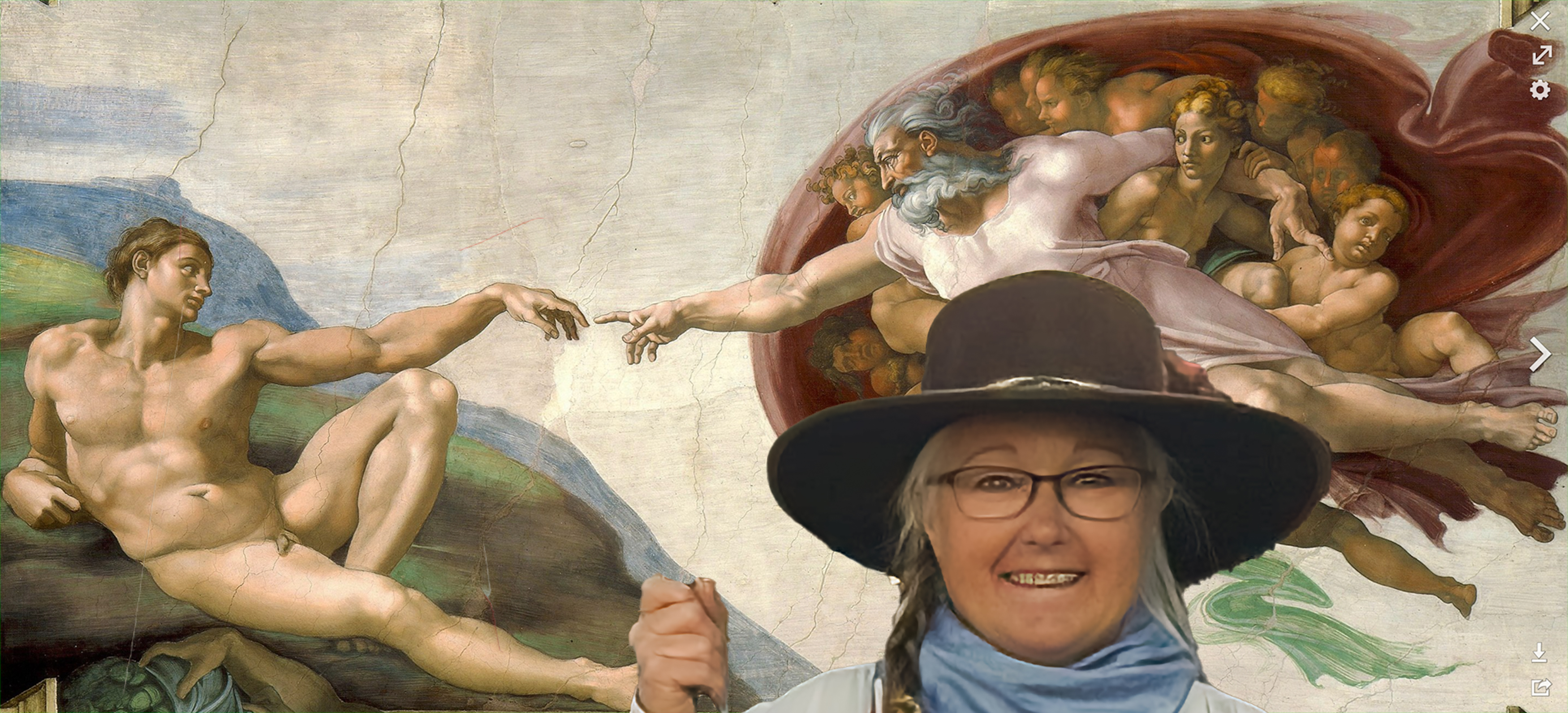

BOCC Chair Amy Mitchell invokes the Heavenly Father

Published in The Flume – 2/16/2023
The final agenda item on February 7, 2023, at the Park County Board of County Commissioners’ work session was a discussion about including an invocation to the quasi-judicial meetings. Quasi-judicial meetings see the commissioners consider factual evidence on various county issues to determine if those facts comport with existing codified processes and procedures. It is a judicial process requiring a determination of fact that demands objective decision-making.
Whether or not invoking anyone’s perception of a higher power into quasi-judicial proceedings is advisable, or even necessary belabored the discussion for several minutes. Likewise, whether or not anyone’s perception of a higher power is necessarily objectively factual was also considered by some.
There were many takes on the issue. Some mentioned that the US Congress and the State Legislature have traditionally begun their sessions with invocations. Therefore quasi-judicial county commissioners’ meetings were just following national and state traditions. The non sequitur is or should be obvious. The US Congress and the State Legislature are not quasi-judicial bodies. The federal and state separation of powers emboldened in both Constitutions is clear. County commissioners, however, occupy that curious space of indeed becoming judicial finders of facts.
It is not tradition to open judicial proceedings in this country with invocations. Even the Founders and Framers would have blanched with such a thing. James Madison would have suggested, Sure, follow your conscience, whatever guides it. But, for heaven’s sake, “What mischiefs may not be dreaded, should this enemy to the public quiet [religiousity] be armed with the force of a law?”
Like many Framers, Madison was influenced by John Locke; Locke and Isaac Newton are considered the fathers of the Enlightenment. Locke was fervent in his criticism of religious overreach. He clearly saw the need to separate the church from the state. “I esteem it above all things necessary,” he said, “to distinguish exactly the business of civil government from that of religion….” In Madison’s Memorial and Remonstrance Against Religious Assessments, he wrote, “What influence, in fact, have ecclesiastical establishments had on Civil Society? In some instances, they have been seen to erect a spiritual tyranny on the ruins of the Civil authority; in many instances, they have been seen upholding the thrones of political tyranny: in no instance have they been seen the guardians of the liberties of the people.”
Locke’s and Madison’s arguments were not anti-religious but explicitly directed at the absolute need to separate religion from civil affairs.
Interestingly, an argument was provided that even the Pledge of Allegiance contains the word, God.
Francis Bellamy, a Christian Socialist Baptist minister, wrote or stole the Pledge of Allegiance in 1890 or 1892 from a kid in Kansas. The word God was added in 1954. Primarily due to the efforts of preachers and politicians during the Cold War to label Commies Godless and remind folks of the questionable assumption that America was the only nation in the history of the world conceived and born by God Himself.
Bellamy preached against capitalism, saying it was evil and destructive of everything Jesus Christ preached. He was eventually removed from his pulpit for such views.
Commission Chair Amy Mitchell opined that an invocation was not a religious activity but simply an attempt to call upon a higher power to guide the commissioners’ decisions.
Why, in a quasi-judicial setting, decisions would necessarily need the help of a higher power rather than simple reliance on codified process and procedure is, at least for me, a conundrum. Some people believe their higher power is starting their chainsaw with one pull. Others believe their higher power is garnered from smelling the roses in the morning. Mitchell obviously believes hers comes from the Christian God.
When considering the facts related to modifying a property’s designation from residential to mixed-used—a quasi-judicial decision—would a higher power have a better idea? Would reliance on God miraculously change the objective criteria for deciding those matters of fact?
Commissioner Wissel noted that an invocation would not change his mind. However, he did say he would recognize and seek guidance from a higher power. Another conundrum.
I suppose if one’s perception of oneself is such that a higher power’s guidance is considered optional, then why seek the advice in the first place?
Commissioner Elsner’s take on adding an invocation reflected the Founders’ and Framers’ essential devotion to the right of conscience. Each person is endowed by their creator with the divine natural right to believe what they wish. However, they are not blessed with the right to impose their beliefs on anyone else.
I have, in past perspectives, suggested the election of Dave Wissel to the Commission, and the elevation of Amy Mitchell to Chair signals a likely culture war agenda. As a result, Christian Nationalistic subject matter will appear on commission agendas. Whether that reflects the best interests of all Park County residents and the essential needs of the county is questionable.
We can only hope divine guidance, at some point, addresses potholes.


