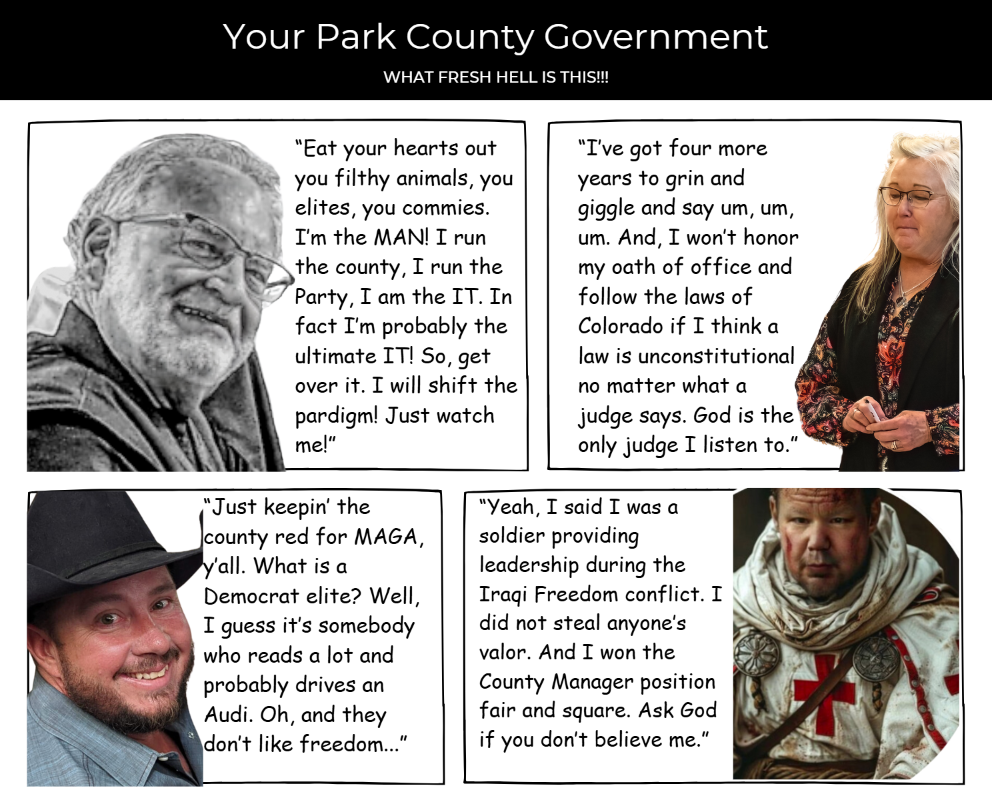

Wissel’s “new paradigm” to control the narrative
Skewing the narrative with specious arguments delivered authoritatively is a strategy that will always fool some people all of the time, even most people, some of the time. Controlling the narrative is a tactic that serves the demagogue’s intended ends, usually an ideological “truth” conjured from the claptrap of inviolable dogmatism. I won’t specify who those fooled folks may be, but we know the intended audience. We know how quickly the intended audience buys the hook, line, and sinker of what, for others, is absolute nonsense.

The latest example was at the March 4, 2025, quasi-judicial 11 a.m. meeting of the Park County Board of Commissioners. The Commission Chair, Dave Wissel, also the Chair of the Park County MAGA—formerly Republican—Central Committee, presided, with District 1 Commissioner Amy Mitchell, District 2 Commissioner Jason Gemmer, and County Manager Lucas Meyer in attendance, each as nodding bobbleheads to Wissel’s narrative.
Simply stated, this post argues that the County Planning Commission is statutorily charged with making and adopting a Strategic Master Plan (called a “master plan” in the legislation). The statutes do NOT allow the Board of County Commissioners or the County Manager to interpose themselves into the Planning Commission’s making of a Strategic Master Plan. No statutory imperative gives the Board of County Commissioners or the County Manager the power to administrate, interject themselves into, or participate in the Planning Commission’s activities, discussions, and decisions regarding making a Strategic Master Plan or adopting the same. The Board of County Commissioners has the sole statutory authority to approve or not the Strategic Master Plan adopted by the Planning Commission.
The discussion concerned the Park County 2025 Strategic Master Plan (SMP), which the Planning Commission has worked hard on for many months. County Strategic Master Plans (master plans) are enabled by Colorado Statute beginning at §30-28-106 of the Colorado Revised Statutes.
§30-28-107 offers a good overview of what the master plan should accomplish:
In the preparation of a county or regional master plan, a county or regional planning commission shall make careful and comprehensive surveys and studies of the existing conditions and probable future growth of the territory within its jurisdiction. The county or regional master plan shall be made with the general purpose of guiding and accomplishing a coordinated, adjusted, and harmonious development of the county or region which, in accordance with present and future needs and resources, will best promote the health, safety, morals, order, convenience, prosperity, or general welfare of the inhabitants, as well as efficiency and economy in the process of development, including such distribution of population and of the uses of land for urbanization, trade, industry, habitation, recreation, agriculture, forestry, and other purposes as will tend to create conditions favorable to health, safety, energy conservation, transportation, prosperity, civic activities, and recreational, educational, and cultural opportunities; will tend to reduce the wastes of physical, financial, or human resources which result from either excessive congestion or excessive scattering of population; and will tend toward an efficient and economic utilization, conservation, and production of the supply of food and water and of drainage, sanitary, and other facilities and resources.
In 2024, several things were changed or added to the Strategic Master Plan statute by Senate Bill 24-174. The bill was primarily, as its purpose reads: CONCERNING STATE SUPPORT FOR SUSTAINABLE AFFORDABLE HOUSING, AND, IN CONNECTION THEREWITH, MAKING AN APPROPRIATION.
The bill was surprisingly nonpartisan. It was sponsored by State Senator Barbara Kirkmeyer from Weld County, our State Senator Mark Baisley, and our State Representative and State House Speaker Julie McCluskie.
As an aside, you may recall that Barbara Kirkmeyer was a Weld County commissioner who, in 2013, was a vocal proponent of her county seceding from Colorado.
The bulk of what SB 24-174 addressed was sustainable affordable housing. However, changes to the Strategic Master Plan statute were nested within it. For our purposes, let’s look at §30-28-106, Master plan – definition:
(NOTE: SB 24-174 also changed Title 31, the enabling legislation for the structure of local governments, including the language for county planning commissions making and adopting master plans, specifically §31-23-206, which reads verbatim to the changes created for §30-28-106, as below.)
(1) It is the duty of a county planning commission to make and adopt a master plan for the physical development of the unincorporated territory of the county, SUBJECT TO THE APPROVAL OF THE COUNTY COMMISSION HAVING JURISDICTION THEREOF. When a county planning commission decides to adopt a master plan, the commission shall conduct public hearings, after notice of such public hearings has been published in a newspaper of general circulation in the county in a manner sufficient to notify the public of the time, place, and nature of the public hearing, prior to final adoption of a master plan in order to encourage public participation in and awareness of the development of such plan and shall accept and consider oral and written public comments throughout the process of developing the plan.
The bolded words were only a minuscule portion of the changes to §30-28-106 in 2024.
Let’s look at Wissel’s reading of that modified section:
Commissioner Wissel
Update, if any regarding strategic master plan and I know Lucas has been involved as well as Commissioner Mitchell.
County Manager Meyer
Yeah. So we are looking at having another Planning Commission meeting tomorrow. We are simplifying the strategic master plan and looking at each different person on that board kind of taking a section and looking at it and reducing it to its simplest form. We do plan to keep the addendum and everything that’s attached to it. Very long and in depth, so that the information is there for…so interested citizens. …Simplified into a more usable format for all citizens…
Commissioner Wissel
And go back to Lucas’s point on a strategic master plan. Yeah, this is probably going to be a couple more drafts in process because we’re, we’re taking this on as a teamwork effort with the Planning Commission, because there have been legislative changes in the ‘24 session that we have to account for in the fact that we used to make the strategic master plan an advisory document and could or could not have the right to adopt or not. Now the law requires us to work with the Planning Commission to adopt a final strategic master plan in concert with them. Heavy lifting really comes down to the Planning Commission in this scenario. And we, we appreciate all the volunteers for their effort and putting forth this, but we had an overpopulation of language and we needed to reduce that down to a usable form. And that’s what I really think this effort is. It’s streamlining the message to make sense. Without being voluminous. And it’s going to be a work in progress.
Commissioner Gemmer
I can absolutely agree with that.
Wissel says, “…there have been legislative changes in the ‘24 session that we have to account for in the fact that we used to make the strategic master plan an advisory document and could or could not have the right to adopt or not. Now the law requires us to work with the Planning Commission to adopt a final strategic master plan in concert with them.“
Here is the language included in SB24-174, and the 2024 amended §30-28-106, and §31-23-206:
THE MASTER PLAN OF A COUNTY OR REGION IS AN ADVISORY DOCUMENT TO GUIDE LAND DEVELOPMENT DECISIONS; HOWEVER, THE MASTER PLAN OR ANY PART THEREOF MAY BE MADE BINDING BY INCLUSION IN THE COUNTY’S OR REGION’S ADOPTED SUBDIVISION, ZONING, PLATTING, PLANNED UNIT DEVELOPMENT, OR OTHER SIMILAR LAND DEVELOPMENT REGULATIONS AFTER SATISFYING NOTICE, DUE PROCESS, AND HEARING REQUIREMENTS FOR LEGISLATIVE OR QUASI-JUDICIAL PROCESSES AS APPROPRIATE.
Here is the language included in the pre-2024 versions of §30-28-106 and §31-23-206:
The master plan of a county or region is an advisory document to guide land development decisions; however, the plan or any part thereof may be made binding by inclusion in the county’s or region’s adopted subdivision, zoning, platting, planned unit development, or other similar land development regulations after satisfying notice, due process, and hearing requirements for legislative or quasi-judicial processes as appropriate.
The 2024 and pre-2024 language is identical.
Either Wissel doesn’t know what he’s talking about, or he’s simply controlling the narrative for his purposes. The language from both versions is precisely the same. The law still considers the SMG an advisory document unless the county commissioners undertake an affirmative quasi-judicial process to approve it. Whether this would be done by resolution or ordinance(s) is unsure.
However, the more revealing portion of Wissel’s narrative is this: “Now the law requires us to work with the Planning Commission to adopt a final strategic master plan in concert with them. Heavy lifting really comes down to the Planning Commission in this scenario. …we had an overpopulation of language and we needed to reduce that down to a usable form. And that’s what I really think this effort is. It’s streamlining the message to make sense. Without being voluminous. And it’s going to be a work in progress.“
No, the law does not require County Commissioners or the County Manager to “work with the planning commission” in some collaborative effort to make and adopt a Strategic Master Plan. That is, by law, the responsibility of the Planning Commission. The Board of County Commissioners can approve or not the work product of the planning commission. That’s it. That’s all the county commissioners are legally empowered to do.
The law doesn’t empower the County Manager to be involved in “simplifying the strategic master plan and looking at each different person on that board, kind of taking a section and looking at it and reducing it to its simplest form. We do plan to keep the addendum and everything that’s attached to it.”
As to reducing in size or editing the work product of the Planning Commission, the most egregious viewpoint comes from Commissioner Amy Mitchell:
If I may, um, you know, I read through a couple of those addendums, and I think they need to be rewritten also because, um, they’re not written in a light that I believe the county would want to present to the public. Um. I think that we want to be forward-looking, positive, and, optimistic and voice reality. Um. And, um, in some sections, I think it is… Um. Does not do that. So I think we’re going to have to review this whole thing because, um, people will use this document to look if they want to move to Park County, they want to make an investment in Park County, um, and we want it to be, of course, absolutely accurate. And educational and insightful, but, um, paint us in a good light also that is completely truthful. So, um, my comments.
Perhaps the idea behind the statutorily driven Strategic Master Plan is that it should not be created by politicians but dedicated citizens with no ideologically driven passion for controlling the narrative. What portions of the SMP addendums would Mitchell like rewritten? The ones with graphs and charts and planning commission narratives expressing honest truths about the county? Or would it be the verbatim citizen survey answers reflecting the differing points of view about the county from just us folks, just us taxpayers?
(See Who is Amy Mitchell and why should we care…)
Wissel celebrates the “new paradigm” that has given him absolute control of the Board of County Commissioners and the Park County MAGA (formerly Republican) Party Central Committee. The paradigm includes the nodding bobblehead Commissioners Mitchell and Gemmer, and asuredly Lucas Meyer, the County Manager slated to occupy that position long before the Commission feigned a competitive process to fill it. Wissel loves peaceful commission meetings now that Jason “Johnboy” Gemmer sits in the chair previously occupied by Dick Elsner. The new paradigm insists there will be no Elsner-type disruptions of the board, those moments we’ve all probably seen where Elsner demanded transparency, usually pointing out, as I often have, that Wissel is full of baloney, Mitchell too.
Would Elsner have questioned Wissel’s control of the specious narrative regarding the Strategic Master Plan? He likely would have. Lord knows Mitchell, Gemmer, or Meyer are not up to the task. Or are they too afraid to rock the “new paradigm” boat?
There are two critical projects we all should be concerned about: The Strategic Master Plan and the proposed Affordable Housing Board, both of which Wissel, Mitchell, Gemmer, and Myer, not to mention several strategically placed operatives on boards and commissions, desire to put their MAGA mark on, or to destroy altogether.
“It seems to me a fundamental dishonesty, and a fundamental treachery to intellectual integrity to hold a belief because you think it’s useful and not because you think it’s true.”― Bertrand Russell
Colorado Senate Bill 24-174


