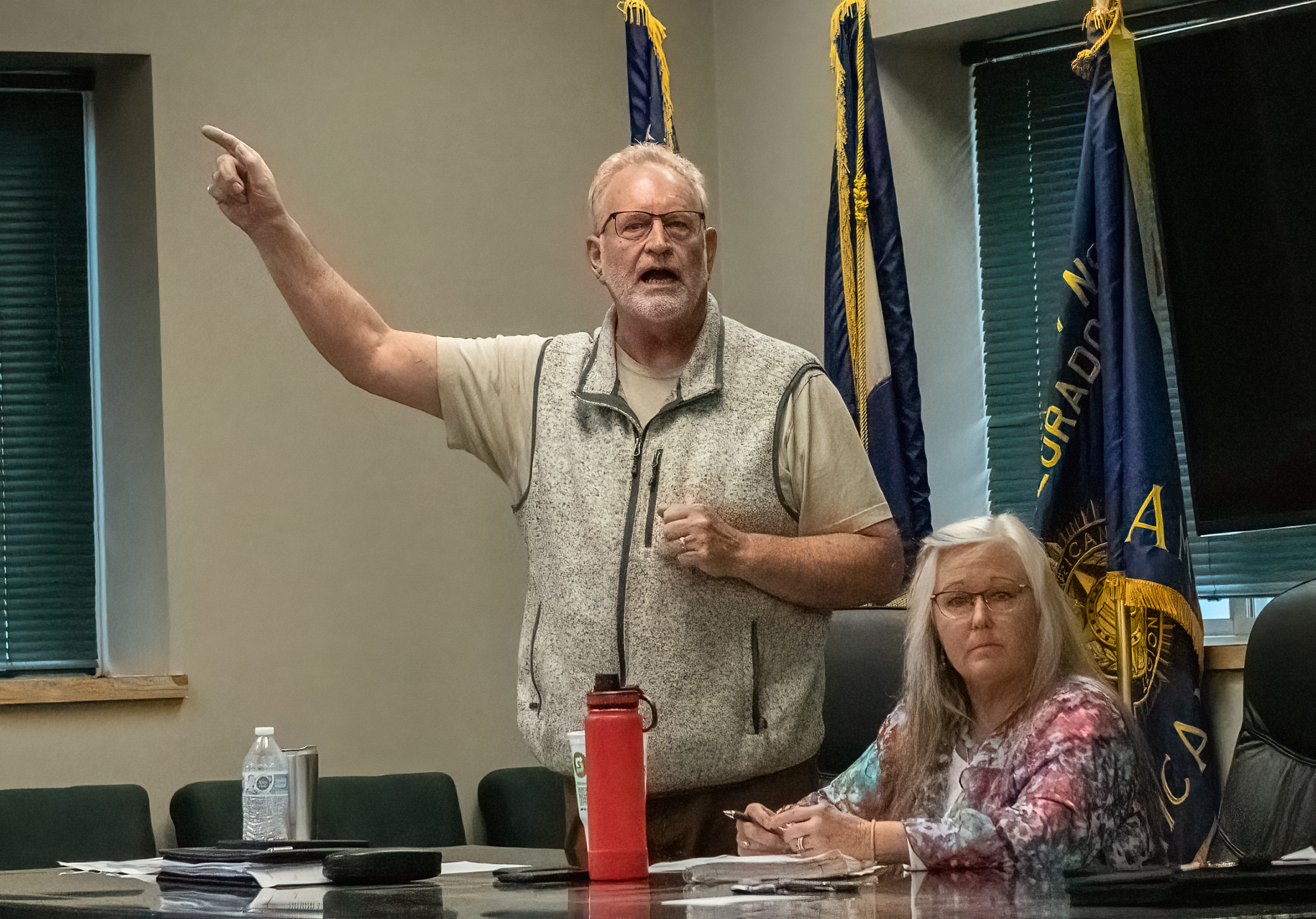

Forget Colorado Statutes. MAGA Rules!!!

Some suggest District 3 Commissioner Dave Wissel is no stranger to ignoring his oath of office. The oath, required of any person entering public office, demands adherence to the US and Colorado Constitutions and Colorado’s laws. See Colorado Revised Statute Title 24, Section 24-12-101.
There are three instances (as far as I know) where folks say Wissel ignored that part of the oath requiring adherence to Colorado’s laws, twice as Assessor and once as Commissioner. Interestingly, those instances were related to assessing property as agricultural for tax purposes.
Designating a parcel as agricultural will save you a chunk of cash on your property tax bill. That’s fine and dandy for running cows, operating a lumber mill, or some other agricultural endeavor as a legitimate business. Those who seek the agricultural designation only for tax purposes, feigning a cow operation with two fat bovines on an acre or two, have been called Hobby Ranchers who may or may not fool the County Assessor into identifying the parcel(s) as agricultural.
The definition of agricultural land is codified in Title 39-1-102 (1.6) (a) of Colorado Revised Statutes.
We need some background from the late ’90s. (I’ve told this story before.)
Let’s say you’re the elected Assessor in Park County, as Wissel was for 38 years. Let’s say you’ve served in that position for nearly two decades by the late ‘90s and know the lay of the land and Colorado law as it applies to property tax and assessments. And, maybe you’ve become a little bold in sometimes believing Colorado Revised Statutes relative to land assessments are wrong, and you are right.
Hell, you’re always right. But, besides that, you’re a Constitutional Conservative and a practitioner of the Code of the West—a real man, a cowboy, a live free-or-die proponent who believes individual rights trump those of the community at large. So, encouraged by your long-lived incumbency, you allegedly dance your fingers across your computer keyboard to reduce the property taxes on your and your good buddy’s (who happens to be your Deputy Assessor) properties. The allegation is you change the residential or residential-vacant designation to agricultural for both the properties, which, by law, really aren’t, but what the hell. Your and your buddy’s tax bill will reflect the savings.
If one has been the Assessor for twenty years, shouldn’t one know the Colorado statutory definition of agricultural property when contemplating changing the designation of two parcels to that designation?
Of course, you should. You are, after all, the public official charged with enforcing compliance with the definition. You took an oath to support the laws of Colorado but allegedly undertook a little sleight of hand, intentionally ignoring the law and your oath to give yourself and your buddy a tax break. Have you just dishonored your oath of office for the first time (that we know of)?
So, after Wissel reclassifies his and his buddy’s property, some citizen—we might call her a Whistleblowing Patriot—contacts the State Property Tax Administrator and drops a dime on Wissel.

Whoa, says the Property Tax Administrator for the state, you can’t do that. “We recommend the removal of the agricultural classification,” she tells Wissel, “for the two parcels in question, yours and Mr. Woodyard’s, immediately as neither qualifies as agricultural under the statutes. We further recommend a complete and comprehensive review of all parcels currently classified as agricultural.” The Administrator provides the relevant statutory citations and case law and offers to assist Wissel in implementing the change to the incorrectly assessed land.
NOTE: Mr. Woodyard was Brian Woodyard, not only Wissel’s Deputy Assessor but also a Director of Wissel’s Upper South Platte Water Conservancy District (Wissel was/is President) and a member of Wissel’s rock and roll band. Wissel’s wife, Lillian, was/is also on Wissel’s water board. For further information on Wissel’s water activities, his and his wife’s private company, GEGE Development, his wife’s lucrative contract with the water district, and other interesting insights, look at What’s Up With the Water and A Wissel Affair.

You probably correct your and your buddy’s records. Most likely, you seethe a bit with the audacity of the Colorado Division of Property Taxation looking over your shoulder and meddling in your business. It’s YOUR county, for God’s sake!
However, it’s alleged that you have not undertaken a complete and comprehensive review of all properties currently designated agricultural, as the state suggested.
Then, wouldn’t you know it, the Colorado Board of Equalization knocks on your door. It finds that an audit of your valuation of vacant land in Park County “was outside the acceptable guidelines as adopted by the state board.” Based on the auditor’s findings, a reappraisal of all vacant land is recommended.
You tell the State Board of Equalization, “Yeah, you’re right, but I don’t have the resources to do it.” Too bad, says the board, which unanimously orders a reappraisal during the new year ahead.
Then some nutcase Yahoo writes a letter to the Governor. He alleges the valuation data on vacant land you gave to the auditor was erroneous, and you knew that within two days of the order to reassess the properties. He further alleges you intentionally did not send the corrected data to the auditor. The allegation is that you needed $38,000 from the county commissioners to buy a software package for the ordered reassessment, which you knew wasn’t necessary because you’d already corrected the data, but you wanted the software anyway. The money would have to come from the overstressed General Fund because you weren’t budgeted for the expense. So what choice did the Commissioner have, knowing a reassessment had been ordered?
“He [the Assesor] has been very successful in duping the people of Park County for several years,” the nutcase Yahoo went on. “Now he has been successful in duping the Colorado State Government.”
Well, you probably stew for about a decade. Probably never forgetting the state’s obtuseness in daring to stick their nose in your business when, Voila!, an opportunity arises for you to strut your stuff.
The State Legislature passed HB No. 11-1146 in 2011. The bill was designed to determine whether or not a residence on an assessed agricultural property was integral to carrying out agricultural operations as defined by law. If not, up to two acres around the residence would be reassessed as residential, thus providing the county a means of collecting appropriate taxes on the property. Part of the law’s intent was to tax so-called “Hobby Ranches.”
Emboldened by your nearly thirty years of incumbency as Park County’s Assessor, you decide, some suggest, to dishonor your oath of office a second time and not enforce the state law. Instead, you say, you’ll flit around its edges.
But Whoa! The Park County Board of Commissioners unanimously issues a statement condemning your flit. “Elected officials are required to uphold and obey statutes, whether or not we agree with them,” it said. Further, they noted that the oath of office you took requires adherence to the laws of Colorado.

Well, that’s nonsense, in your opinion. You will not enforce any federal, state, or local law if, in your opinion, it does not comport with the Constitutional rights of the people. Your opinion? Well, that’s simple. Individual rights always trump the collective rights of the community. Why enrich county coffers by appropriately assessing and taxing properties that falsely claim to be agricultural operations? No. You wouldn’t want to invade those folks’ privacy by inquiring into the legitimacy of the claim their residence is integral to agricultural operations. People are entitled to their privacy. And, by God, the legislature ought to make enforcement of the law optional for county assessors anyway.
As always, you’re right, and anybody who disagrees with you is wrong.
Wissel devised a song and dance about creatively implementing the spirit but not the rule of the new “Hobby Ranch” state law. He keyed on wells, determining if a well was near the residence. If so, then that well was ipso facto evidence the said residence was integral to the claimed agricultural operation. But, being a man of people, Wissel didn’t thoroughly investigate the validity of claimed agricultural operations because that would have intruded on folks’ privacy rights. He called the new state law “stupid,” and, by golly, he was going to do something about it.
In 2013, Wissel teamed up with Kevin Grantham, a state senator from what would become Boebert country to our south, who sponsored Senate Bill 13-132, which would solve everything. It would give county assessors sole discretion to determine whether a property was agricultural.
SOLE DISCRETION, for goodness sake! Imagine that! Would even the State Property Tax Administrator, who chastised Wissel a decade before, be out of the loop? The State Board of Equalization? Hell, even the County Board of Equalization (composed of the County Commissioners) would have no say in the decision.
Kings and emperors enjoyed sole discretion. In the 18th century, we eliminated a king’s sole discretion over our lives. Yet, I’m not naming names; some would still be kings. Or emperors?
When even agricultural entities in the state were dubious about Senate Bill 13-132, its fate was sealed. So Grantham pulled it from consideration even before getting a committee hearing.
“It died a quick and painless death,” Wissel said at the time.
Now comes November 19, 2024. The Board of County Commissioners heard three abatement cases that day, one of which was from a fellow who’d lost his agricultural status because, as the Assessor, Monica Jones, said, his property does not conform to what state statute says it must be to be assessed agricultural. The property had agricultural status via a lease (pleasure horse trails) when the fellow purchased it. However, it had not been used as agricultural land for over a year.
Assessor Monica Jones, applying the statute’s provisions, asked the Commissioners to deny the fellow’s petition.
Well, the petitioner stepped to the podium and performed his song and dance about misunderstandings with the Assessor’s Office, his efforts to run a couple of cows on the property, milling wood, new fencing, and his intent to run a full-scale cattle operation on the property eventually and maybe a full-time milling operation as well.
Any reasonable person listening to the evidence would conclude, as I did, that this fellow was working toward the statutory requirement that the property be used continuously for two years as agricultural (as defined by statute). In January of the third year, the property would be zoned as agricultural because the petitioner would have met statutory requirements for that to happen. Slapping up some fencing and running one or two cows on the property does not comport with the statute’s provisions. It’s a start, but you’re not there yet.
Regardless of the petitioner’s understanding or misunderstanding, the law is the law. (Well, until the Potentate of Mar-a-Lago redefined the rule of law in America. But that’s another story.)
But wait! Commissioners Wissel and Mitchell saw an exception to the law. They saw a unique situation requiring a little fudge here and a little slip-slide there with the statute. So what if this slippery slope not only dishonors their oaths of office but also creates a precedent that will haunt the assessment of agricultural parcels for years to come?
“I would like to offer this as an exception and unique circumstances,” Wissel said when Commissioner comments were called for. He said it was an individual property appeal, not a class action. He mentioned that the petitioner had installed a well, for goodness sake. That alone should qualify it for agriculture.
Wissel likes the water well argument, coupled with the construction of a residence. He used it in 2012 with the Colorado State Board of Equalization when arguing the merits of his non-compliance with state statute. In 2012, The Flume reported on that meeting, saying, “Kyle Hooper, the appraiser for vacant and agricultural classes for the Colorado State Board of Equalization, said at the meeting that he believed water could be considered a material aspect integral to an agricultural operation. “‘However,’” said Hooper, “‘the statute specifically states you do have to review what the individual occupying the residence is doing,’ he said. ‘It says specifically if the occupant occupying the residence regularly conducts, supervises, or administers material aspects. That indicated that there needs to be some sort of physical involvement, not just the fact that if water is a material aspect.’”
What Hooper conveyed to Wissel was, yes, a well may be integral to the operation of an agricultural endeavor per statute, but are the folks occupying the residence near that well involved in conducting, supervising, or administering material aspects of the agriculture operation? If not, those folks have no recourse against up to two acres surrounding their property being reassessed as residential.

At the November 19, 2024, BOCC meeting, Amy Mitchell, Dave Wissel’s ideological doppelganger, spoke up and said, Hey, the guy intends to have himself an agricultural operation on the property. He’s working to make that happen.
Wissel then proclaimed that his fudging on the requirements of Section 39-1-102 of Title 39 of the Colorado Revised Statutes gave the petition a chance to redress a perceived wrong done to him by the government.
Commissioner Elsner and Assessor Jones disagreed. Assessor Jones specifically noted that intent is not a valid substitute for meeting the definitional requirements of what agricultural property is.
The County Attorney, undoubtedly seeing the immense danger in Wissel’s and Mitchell’s sleights of hand with statutory requirements, urged Mitchell to read into the record a bit more about why she found the particular case unique. She advised that when the same or a similar scenario occurs in the future, the Assessor would need to reflect on that record to, once again, discover the justification for violating state statute. In other words, Mitchell’s and Wissel’s conclusions reflected a stark diversion from statutory requirements and, indeed, from a plethora of case law addressing this very issue.
So, if we’re counting, some say Commissioner Wissel has violated his oath of office at least three times. Amy Mitchell at least once. But, some will say they just skirted the statute for We, the People. Governments are oppressive, they’ll say. Wissel and Mitchell just provided a means for the oppressed to achieve redress. So what if the damned statute wasn’t followed. Statutes are enacted to be ignored. Right?
For me, January 6, 2021, remains a very dark and dangerous period in our history, during which so-called Patriots sought to dismantle the Constitution. Our Constitutional Republic, via the rule of law, elections, legislation, and court review, provides the ordered, legitimate, democratic method for redressing grievances in a society dedicated to preserving the components of what a constitutional republic is. Those are the norms. Alas, we live in abnormal times.
NOTE: The bulk of this post was written before the November 26, 2024, Board of County Commissioners meeting. Wissel’s and Mitchell’s pathological ugliness at that meeting ruled the day. Their decision to oust the Interim County Manager, Mike Smith, not only from that position but from his permanent position as Director of Operations was an expository revelation of the extent they’re willing to go to make Park County the Jewel of MAGA, a demagogic paradise, an authoritarian enclave where We, the People, are only those who, yes, are willing and now able to ignore the rule of law, to pursue retributions with impunity, to embrace the county in the darkest shadows of America First.


