
An overview: History of healthcare in Park County and the proposed Platte Canyon Health Service District.

Table of Contents
- History – Metro Community Health/Platte Canyon Medical Clinic in Bailey – 2004 to 2009
- History – Crow Hill Family Medical Center – 1977 to Late ’80s
- History – National Health Service Corps in Bailey – 1972
- Dr. McNamara – Fairplay and Bailey Clinics – 1966 to 1972
- History – Fairplay McNamara Hospital – 1966 to 1984
- History – Fairplay Paupers Hospital – 1889
- Current Health Service Districts in Park County
- South Park Health District
- Ute Pass Regional Health Service District
- South Park Ambulance District
- What is a Health Service District in Colorado
- Park County Health Assessment and Improvement Plan Presented to BOCC
- The Process – Platte Canyon Health Service District
- Map of Commissioner Districts
- Colorado Revised Statutes Title 32 – Special Districts
- Park County Health Assessment and Improvement Plan – 2023
- Platte Canyon Health Service District Plan
- Timeline for Platte Canyon Health Service District Ballot Questions
- Video – June 27, 2023, BOCC Work Session and General Meeting re: Health Assessment/Improvement Plan
- BOCC Bailey Town Hall – Health Service District Discussion – June 29, 2023
- Letters of Support for the Platte Canyon Health Service District
- Final Thoughts
The history of healthcare facilities in the Platte Canyon area is instructive to the current effort to establish a Platte Canyon Health Service District in accordance with Colorado statutory authority for counties/citizens to do so. The history provided travels from the most recent to the most dated, starting in approximately 2oo4 and going back to 1889. I’ve included historical narratives for Fairplay’s health service, not because they’re particularly relevant but interesting.
Metro Community Provider Network/Platte Canyon Family Medical Clinic – 2004 to 2009

On September 16, 2009, the Metro Community Provider Network health (MCPN) care clinic/Platte Canyon Family Medical Clinic at 460 County Road 43 in Bailey stopped seeing patients. It had been in operation for five years, but “due to state government cutbacks,” David Meyers, president, and chief executive officer of the clinic, said, “the nonprofit organization was forced to terminate business in Bailey and drop two other programs in metro Denver.”
It was the “Great Recession” of the latter part of the 2000s. The International Monetary Fund called it the most severe economic and financial meltdown since the Great Depression of 1929-1939. In America, you may recall, the recession was fueled mainly by the subprime mortgage crisis.
In October 2009, Governor Ritter was prepared to cut $280 million from the state budget. Thus, the demise of the MCPN/Platte Canyon Family Medical Clinic.
MCPN was formed in 1989 as a nonprofit to serve the uninsured. At its closing, MCPN saw 500 patients during office hours only two days a week, Wednesday and Thursday. Their fees were based on a sliding scale discounting a person’s ability to pay based on family size and income up to 250 percent of the federal poverty level. Their goal was to match expenses to income, something they apparently could not do.
Reorganized in 2019, the Metro Community Provider Network changed its name to Stride Community Health, which currently has a location in Conifer.
Crow Hill Family Medical Center
Predating the MCPN health clinic in Bailey was the Crow Hill Family Medical Center, established by Dr. Frank Reed in 1977. By 1982, Reed sought a second physician, and Dr. Tom Syzek joined the practice. It is uncertain how long the Crow Hill Family Medical Center provided services. Speculation is that it operated into the mid to late-80s. By 1984, Reed had significantly reduced his participation in the practice when he became Director of Clinical Services in the Department of Family Practice at Rose Medical Center. Dr. Syzek returned to Ohio in 1989, where he had received his medical training.
The Crow Hill Family Medical Center had 5,000 patient visits in 1979 and 9,000 in 1983. Or roughly 35 patients every working day. It was a for-profit endeavor.
Dr. Reed, who lived in the Platte Canyon area, said the planned discontinuance of the National Health Service Corps (NHSC) program in Bailey was the impetus for establishing his private practice medical center.
The National Health Service Corps was established in 1970 and provided a portion of educational loan repayments to physicians and other healthcare workers in return for two years of service in communities underserved by healthcare resources. In 1972, there was an MHSC site in Bailey. Living in the area, Dr. Reed was familiar with the area’s healthcare resources. He also knew a National Health Service Corps site in Bailey, Colorado, was scheduled for phasing out. Dr. Reed considered becoming a National Health Service Corps physician and taking over the practice in Bailey but instead decided to establish a private family practice in the community in 1977.
Perhaps the viability of the Crow Hill Family Medical Center began to crack when the decision was made to move toward direct payment for services and away from third-party billing. In 1983, it stopped honoring Medicare assignments.
It is unknown whether the Crow Hill Family Medical Center survived until 1989 when Dr. Syzek returned to Ohio.
Dr. McNamara – Fairplay and Bailey Clinics – 1962 to 1972
Continuing to step back into history, beginning in 1962, Dr. Bradley Edward McNamara, “Dr. Mac,” moved his family from Michigan to Park County. He’d served as a doctor in WWII and was skilled as an emergency surgeon. He practiced in both Fairplay and Bailey. In 1966, he built a hospital in Fairplay bearing his name. The Bailey clinic closed in 1972, and Dr. McNamara died in 1973. He served as the County Coroner and was a member of the first Planning Commission.
Fairplay Healthcare
Not relevant to the proposed Platte Canyon Health Service District, healthcare in Fairplay is interesting from a historical viewpoint.
A Parked in the Past article from The Flume, dated November 23, 2011 (linked), tells us, “Within three years of opening, the new McNamara Hospital was in the red. In 1969 it was in debt by $46,000 and by 1973 the debt was $65,000, according to a letter of Oct. 10, 1972, to then Governor John A. Love from Roy Cleere, M.D., the then-state director of public health. Adjusting for inflation, the figures seem substantially higher, $284,000 in 1969 and by 1973, $402,000. The letter asked for “financial relief from the Governor’s Emergency Fund.” An article in the Oct. 30, 1992, Flume recapping the history of McNamara Hospital tells of efforts to recoup losses. Mercy Hospital leased McNamara, and it became known as McNamara-Mercy. The county commissioners took back control in about August 1980, but it was leased out again, this time to Porter Hospital, in September 1981 until Nov. 21, 1984, when the hospital closed for good. After the hospital closed, the building was used in succession as the South Park Clinic, the Silverheels Clinic under the auspices of Park County Rural Health, and as various county offices. It was condemned and vacated in 2009.”
Going back even further, specifically concerning Fairplay, here’s a story from the July 2014 issue of Park County Local History Archives:


What is a Health Service District
The MCPN/Platte Canyon Family Medical Clinic, the Crown Hill Family Medical Center, the McNamara Clinics and Hospital, and the Paupers Hospital going back to 1889 were not operating under the auspices of an established health service district.
Health Service District are created under Colorado Revised Statutes Title 32, “Special Districts,” which defines health service districts as: “…a special district that may establish, maintain, or operate, directly or indirectly through lease to or from other parties or other arrangement, public hospitals, convalescent centers, nursing care facilities, intermediate care facilities, emergency facilities, community clinics, or other facilities licensed or certified pursuant to section 25-1.5-103 (1)(a), CRS, providing health and personal care services and may organize, own, operate, control, direct, manage, contract for, or furnish ambulance service.” 32-19-114: “Cooperation between districts or other existing providers permitted. A health assurance district and a health service district shall each have the authority to contract with or work cooperatively and in conjunction with another health assurance district or health service district, or any existing healthcare providers or services to provide healthcare services and facilities to the residents of such districts.”
A Health Service District is governed by a five-member board of directors, initially elected when the ballot question to establish the district is presented to the proposed district’s voters.
The health service district has the statutory authority under CRS 32-1-1003 to: “(5) Any health service district that is created pursuant this article shall have the power, upon approval by the eligible electors of the district, to levy and collect a uniform sales tax throughout the entire geographic area of the district upon every transaction or other incident with Colorado Revised Statutes.”
A health service district is a public entity with the statutory ability to form cooperative agreements with public or private providers of health-related services, such as a fire district, to serve the district’s needs best. Unlike the Metro Community Provider Network healthcare clinic/Platte Canyon Family Medical Clinic and the Crown Hill Family Medical Center did not have the support of a locally publicly funded entity with statutory authority to proactively enhance the viability of healthcare service delivery to the district’s citizens.
Current Health Service Districts in Park County and one Ambulance District
Two health service districts, the South Park Health Service District (SPHSD) and the Ute Pass Regional Health Services District (UPRHSD), encompass portions of Park County. Additionally, there is a South Park Ambulance District in Park County.
South Park Health Service District

The SPHSD was formed in 2017. Its coverage ends at Jefferson’s west boundary and Hartsel’s south boundary. Guffey and Lake George chose not to participate in the district. It has a Fairplay clinic managed by Heart of the Rockies Regional Health Medical Center in Salida. It is funded through operating revenue, a 1% sales tax on all taxable transactions, and grant or program funding. As of December 27, 2023, it has no debt and was anticipated to begin 2024 with nearly $2 million on the ledgers.
Ute Pass Regional Health Service District

The UPRHSD was statutorily formed in 2004, and updated their service plan in 2011. Its coverage is primarily Teller County and overlaps portions of Park, Douglas, and El Paso counties. It provides emergency and non-emergency ambulance services, mental health, and other paramedic services. It is funded through operation revenue, a 3.99 property tax mill, a half-cent sales tax, and grant or program funding. As of December 14, 2023, its 2023 ending fund balance was $3,165,329.
On April 23, 2024, James “Tiny” McLaughlin, PACT/MIH Director (Paramedic Advanced Care Team/Mobile Integrated Healthcare), presented to the Park County Board of Commissioners during a work session regarding the UPRHSD Mental Health Assessment program. His remarks included the statistic that 58% of their mental and behavioral health-related calls come from Bailey. He concluded his remarks by saying, “I know you guys are, as a community, looking at options, and we are extremely supportive of anything that increases access for persons in your community.” He noted that some calls were missed because of Geographical issues, weather, volume, and the amount of time it takes to get to Bailey.
South Park Ambulance District

The South Park Ambulance District was statutorily formed in 1992. It covers 1500 square miles of Park County (see map above) but not the Platte Canyon area where the proposed health district will be established. It is funded by a 10.28 mill levy property tax, user fees, grants, and other program funding. Its ending 2023 fund balance was $3,081,727.
Park County Health Assessment and Improvement Plan Presented to BOCC
Lynn Ramey, Director of Park County Public Health, submitted the Park County Health Improvement Plan on June 27, 2023, to the Park County Board of Health. The plan was discussed in a BOCC work session on that day and later approved by the BOCC at their quasi-judicial general meeting. The plan noted support for establishing a health service district as a priority.

During the work session, the discussion saw Commission Chair Amy Mitchell offering the fait accompli that since Park County has a paucity of health service resources, the only reasonable option is to rely on neighboring counties to provide those services. Later, during the general meeting, she said, “We’re being creative. …I think communication on where people in the pockets, on the edges of the county, where they might be able to cross the county line for help. …Transportation is the biggest nut. …It is really hard to service the fractured structure we have in the county.”
Mitchell’s conclusions are not so much to highlight that she is willing to shove the healthcare needs of Park County citizens onto neighboring counties, but perhaps more significantly, she is willing to concede Park County citizens need to suck it up, put gas in the car, buy bus tokens, call a taxi and take your ills across the county line.
Commissioner Wissel’s concerns on June 27, 2023, centered on the “outlying areas, the hinterlands” while acknowledging “our point of service is basically our population centers.”
Commissioner Elsner spoke about the unavailability of healthcare services in Conifer (Jefferson County) because Conifer Medical Center is typically overbooked and does not take new Medicare or Medicaid patients. He discussed Park County’s northeast quadrant being predominantly an aging population and the difficulties of going “down the hill” for medical care.
The Park County Health Improvement Plan was unanimously passed at the BOCC quasi-judicial general meeting on June 27, 2023. Two days later, further discussion of a health service district for the northeast quadrant, the Platte Canyon area, was provided at the BOCC Commissioners Town Hall in Bailey.
The Process – Platte Canyon Health Service District
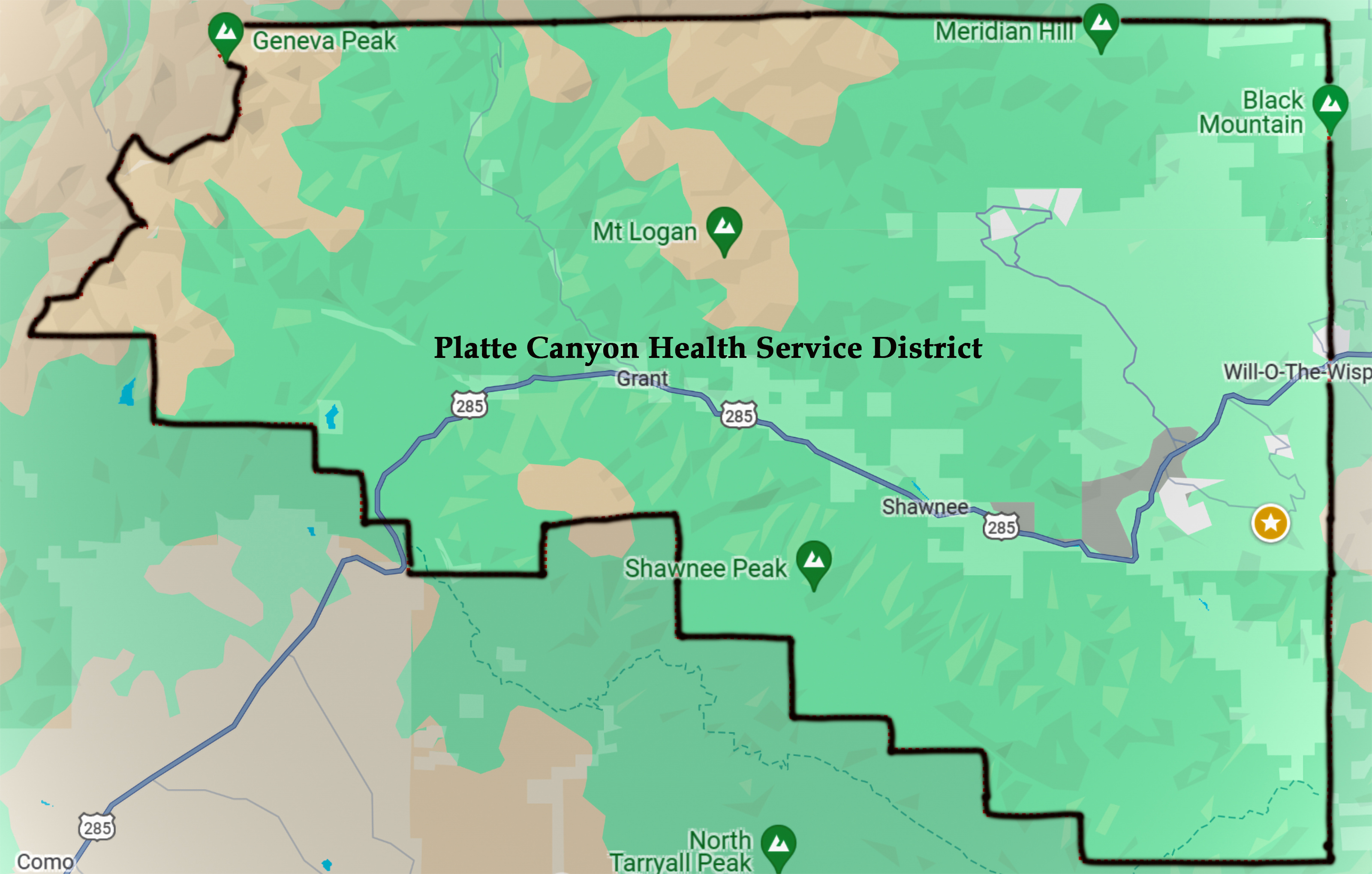
The Park County Board of Commissioners plays a vital role in allowing the citizens of the proposed Platte Canyon Health Service District (PCHSD) to decide whether to establish the district. The proposed district includes Bailey, Pine Junction (Park County side), Shawnee, and Grant. It overlaps the Platte Canyon School District.
The process is set into motion once the PCHSD Committee submits the Health Service District Plan to the BOCC to request a hearing date for its consideration. This was done at the April 16, 2024, meeting, and the hearing date is scheduled for May 14, 2024, at 11 a.m. Attendance at that meeting can be in person, by telephone, or by Zoom. Check here for the Zoom link once the agenda for the May 14, 2024, meeting is posted on the BOCC Agenda site.
CRS Title 32 prescribes the step-by-step establishment of a health service district in a county. This is further addressed in the Health Services District—Organization Timeline and Process provided to the Park County Board of Commissioners, linked here.
The Proposal to The Board of County Commissioners of Park County, Colorado, For the Organization of A Health Service District to Serve the Northeast Region of Park County, Colorado, is here.
The proposed Platte Canyon Health Service District does not include the ability for an ad valorem property tax hike but a 1% sales tax to fund its operation, as well as service fees and grant monies and other sources of revenue that may be available to it. It will NOT affect property taxes.
It is instructive that the entirety of Dick Elsner’s Commissioner District 2 will be served by the proposed health service district, encompassing at least 5,856 of the below-noted active voters. The proposed health service district will serve a portion of Amy Mitchell’s District 1, encompassing approximately 2,996 of the below-noted active voters. None of Wissel’s commissioner district is in the proposed health service district. Elsner has advocated for a health service district in the county’s northeast quadrant for years. For reasons articulated below and gleaned from the June 29, 2023, BOCC Bailey Town Hall videos, it is uncertain if Mitchell and Wissel will support the proposal.
Elsner’s small Commissioner’s District 2 population is more significant than Wissel’s huge District 3 and Mitchell’s equally huge District 1.

If no later than June 3, 2024, the BOCC, by a majority vote (at least two yea votes), approves the proposed health service district service plan submitted on April 16, 2024, and considered by the BOCC on May 14, 2024, the process will continue. The collection of signatures to place it on the ballot ONLY for those registered voters who live in the proposed district will commence.
It would be unconscionable to deny the citizens within the proposed district the opportunity to decide whether to proceed with the proposed health service district. The manta, We, the People, would apply here, especially for those who claim allegiance to that sentiment.
BOCC Bailey Town Hall – Health District Discussion
On June 29, 2023, there was a Park County Commissioner Town Hall in Bailey at the Platte Canyon Fire District Headquarters. Among the topics discussed was a health service district for northeast Park County. The questions, answers, and reflections on both are at least informative and perhaps predictive of what may arise in the BOCC hearing scheduled for May 14, 2024, at 11 a.m.
The Topics related to the health service district on June 29, 2023:
Video 1: Will each commissioner allow the County Attorney’s office to help the citizens’ group set up a Northeast Health District? (05:31 minutes)
Commentary directly related to Video 1
An attorney not associated with Park County assisted with the formulation of the Platte Canyon Health District Service Plan. Mitchell’s and Wissel’s objections to the county attorney assisting pro bono, on her own time, was, as my father would say, chickenshit. I agree, however, that the county attorney’s responsibility is to the BOCC and not to citizens individually or as a group.
The citizen commented that the BOCC’s attitude appears to be “Fairplay gets, Bailey doesn’t get.” And, “I think all of you commissioners need to understand that the majority of the population of the county lives over here. And the way you are treating Bailey is totally disrespectful, from the Rosalie property…” Applause obscures her additional statements.
The crowd at the Town Hall was equally divided between the Wissel and Mitchell contingent and the Elsner contingent via the aisle down the middle of the room. It was predictable that Wissel would put on his demagogue hat to spew and sputter irrelevancies about a defunct hospital in Fairplay. “We had at one time in my life here a hospital and a hospital district. We supported everybody. The only hospital there was Fairplay, and the babies from Summit were born in Fairplay.”
Assuming Wissel is talking about the McNamara-Mercy or McNamara-Porter hospital, I find no evidence its operation was under the auspices of a duly established, statutory hospital district. During his rant, interestingly, he said, “You want to have it here [a health service special district] great, we’re for it.” Whether or not he will eat those words on May 14, 2024, remains to be seen.
Video 2: Joyce Hines, 1st Vice Chair of the Park County Republican Party, inquires about Stride in Conifer and posits a clinic in the northeast quadrant has historically not been successful and wonders if the northeast health district would prescribe and administer puberty blockers or surgery to our children. (05:17 minutes)
Commentary directly related to Video 2
I’ve written extensively about the MAGAtization of the Park County Republican Party. Joyce Hines, the first Vice Chair of the PCRP Central Committee, reflects that. Her question mirrors what I call politics as performance art. To ask such a question about a non-existent health service district served only to press the buttons of those not attuned to her Christian Dominionistic ideology. That she wanted Mitchell to answer the question rather than Elsner was clearly to allow Mitchell to strut some demagoguery of her own. Mitchell didn’t take the bait. However, Mitchell did expose her ignorance of how a health service district operates, and Voila! announced that she doesn’t “…go to doctors.” Indeed, that qualifies her to make an informed decision on May 14, 2024.
Wissel then began a monologue about his personal experience with health and hospitals. His mother worked at one in Kiowa County when he was a kid. That’s a gold-plated qualification for an informed decision on May 14, 2024. I’ve noticed that when Wissel doesn’t know much about a subject, he goes off on these nostalgic soliloquies, apparently believing anyone cares. Most don’t, except, of course, for his loyal constituency.
Wissel related that tiny Kiowa County, where he grew up, established a hospital, a doctor, a pharmacy, a nursing home, assisted living, ambulance service. “They didn’t wait around for people to do it,” he said. “They took themselves by the bootstraps and did it. They worked to get that done!”
We will remind Wissel that Kiowa County’s “surreal” health services are provided pursuant to a statutorily created health district supported by a property tax mill levy.
Kiowa County’s hospital service district is, if not surreal, then at least awesome. The county’s dedication to its citizens’ healthcare is an instructive history Park County commissioners should examine closely. From its inception in 1937 to the multiplicity of economic advantages provided by its statutory health service district, Wissel’s hometown county of only about 1500 souls has seriously pursued health care for its citizens.
Wissel also contends that from “his research,” he’s found “…there are nine [health service districts] of them in the state.” May we point out that there are, in fact, forty (40) Title 32 Health Service Districts in the state? (Data from Colorado Department of Local Affairs – Active Local Governments.)

Wissel says he looked at the finances of the “Northwest Health Facilities District.” I find no evidence of such a District.
It is essential to point out that county boards of commissioners do not administer the budgets of health service districts, nor do they have oversight of the district’s finances. An elected health service district board is statutorily responsible for those imperatives; county commissioners are not.
These comments cannot help but raise the question, Why hasn’t the BOCC taken itself by the bootstraps and provided adequate health care services for all of Park County and not waited for people like the citizen’s group working on the Platte Canyon Health Service District to do it? Couldn’t Park County emulate little old Kiowa County?
And there was more demagoguery. Wissel said he was concerned about the financial aspects of health service districts. To illustrate, he spewed a demagogic rant about the charges inappropriately added to Bailey residents’ CenturyLink monthly landline bills for the South Park Health District. This was a glitch in CenturyLink’s billing system and not, as Wissel implied, a scurrilous conspiracy by the South Park Health District.
Video 3: Discussion about Stride in Conifer. (04:21 minutes)
Commentary directly related to Video 3
This fellow–seated in the raw-red-meat section of the crowd–touted Stride in Jefferson County, suggesting Park County residents spend three or four years helping Stride build its business in Conifer. Stride primarily serves uninsured and Medicaid patients. Wouldn’t it be wonderful if the self-insured folks in Park County supplemented the clinic? His conclusion was telling: If Stride doesn’t work out for Park County residents then okay, maybe a health services district in northeast Park County might be the way to go.
The obvious question is why the Stride facility in Conifer still provides a doctor and nurse only two days a week after two years of operation. Is it not catching on with the citizens of Conifer? The MCPN/Platte Canyon Family Medical facility, operating in Bailey for five years, ending in 2009, also provided services only two days a week. Has the northeast quadrant of Park County already been there/done that? Why devote three, four, or five years to something that will likely fail?
Would it not be more sensible for Stride to consider taking advantage of participating in a Platte Canyon Health Service District in Park County rather than the business model they’ve established in Conifer, Jefferson County, and unsuccessfully utilized in Park County nearly two decades ago?
Commission Elsner provided the retort, citing the ability of a health service district to not only consolidate services under one umbrella but also its ability to seek grants and other sources of funding.
Video 4: Since the Park County Health Improvement plan includes support for establishing a Northeast Health District, will commissioners plan to put that on the ballot? (02:26 minutes)
Commentary directly related to Video 4
Mitchell again exposes her ignorance about the fundamentals of a health service district. Having previously stated that she “…doesn’t go to doctors,” she lectures folks that long commutes to get health care is not a problem. Go figure. The inadequate Stride solution is brought up again, and the ending comment is central to this whole discussion: “Why not let the people vote on it? We’re just asking you to put it on the ballot so we can vote.”
Platte Canyon Health Service Plan
Timeline for Platte Canyon Health Service District
Letters of Support for the Platte Canyon Health Service District
Final Thoughts
My position regarding establishing a Platte Canyon Health Service District is obvious. I’m for it. But the information I’ve provided isn’t for me. It’s for you. Knowledge is power, and the history and current state of healthcare in the proposed district (and Park County as a whole) will hopefully inform and educate those seeking information and knowledge in anticipation of the Park County Board of Commissioners meeting on May 14, 2024, at 11 a.m. (Check the Park County Agenda Center for the May 14 agenda to appear and the Zoom link to view the meeting remotely.)
At that meeting on May 14, the Park County BOCC will vote yea or nay to allow the measure to establish the Health Service District to be placed on the November ballot. Only qualified voters in the district can vote up or down on the measure. Democracy (small d) in action, huh?
I sincerely hope that what I’ve provided here will accomplish its intended purpose: to inform and educate. Please let me know if I’ve got something wrong or something important should be added.
Finally, my biases, for which I will not apologize, are apparent.


