
2023 Bond Renewal Ballot Question 4A
“Education costs money, but then so does ignorance.” – Claus Moser
“Every time you stop a school, you will have to build a jail. What you gain at one end you lose at the other. It’s like feeding a dog on his own tail. It won’t fatten the dog.” – Mark Twain
Contents
- The Question
- Constitutional and Statutory Education Requirements
- School Financing – Where is Platte Canyon Statistically
- District History
- Platte Canyon School District RE-1 – Facilities
- Master Plan Detail
- Issues – False and/or misleading narratives/statements
- 2023 4A Con statement with Responses/Corrections
- My thoughts
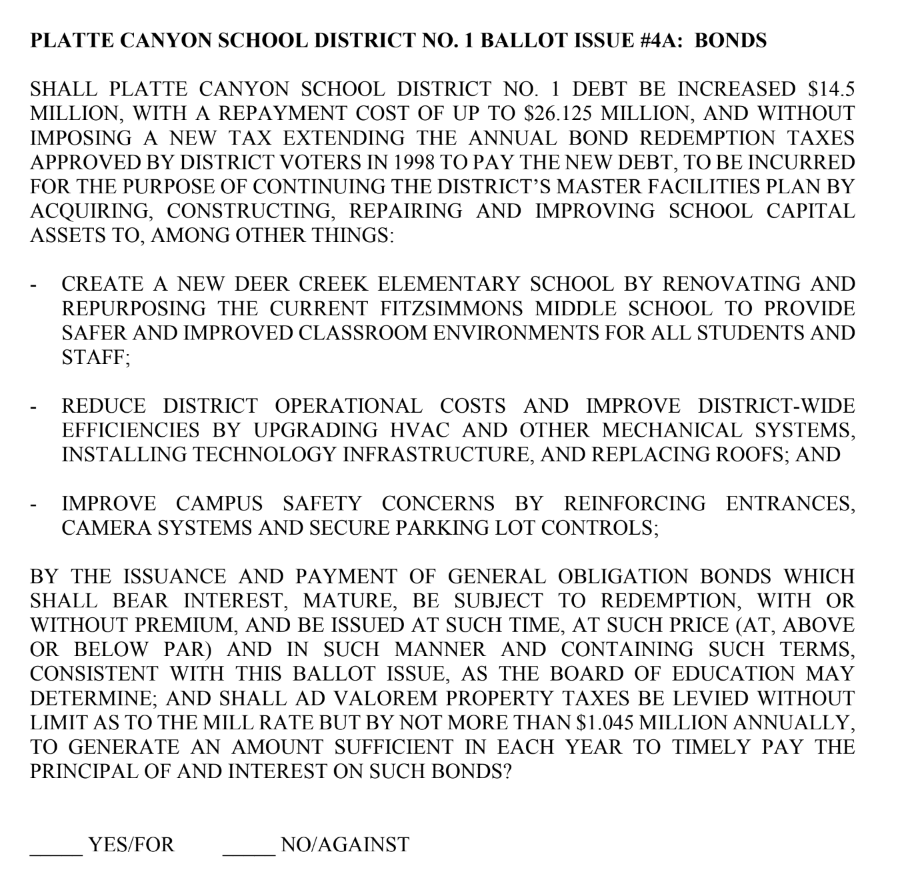
The Question

Constitutional and Statutory Education Requirements


Article IX of Colorado’s original Constitution, ratified on July 1, 1876, established the responsibility to educate the state’s children, ages six to twenty-one.
Today’s Colorado Revised Statutes, Title 22, “Education,” encompasses present-day requirements for educating the state’s children. It’s over a thousand pages, and I admit I haven’t read the entire thing.
School Financing – Where is Platte Canyon Statistically
Financing for public education in Colorado is primarily achieved by a combination of state and local sources. The state’s share of district funding varies based on the local tax revenue generated in each district. The complexity of how funds are distributed to each district is a journey through a labyrinth. I have gleaned that the formula for per-pupil spending reduces the state’s contribution if the local contribution increases. Here’s a helpful link
Notably, Colorado ranks 34th in the nation for total per-pupil funding and 31st for teacher pay. (Different data sites note slightly different stats for these categories, but they’re all in the same neighborhood.)
Significantly, the last census revealed “Of the 20 states with the lowest per pupil spending, 17 (Alabama, Arkansas, Arizona, Colorado, Florida, Georgia, Idaho, Kentucky, Mississippi, North Carolina, New Mexico, Nevada, Oklahoma, South Carolina, Tennessee, Texas and Utah) were in the South or West regions. The remaining three were Missouri, South Dakota, and Indiana.”
District History
Let’s talk about the Platte Canyon School District RE-1. Home of the Huskies
The district traces its history back to 1897, citing the Slaghts School near Shawnee as the first structure (one room) dedicated to education in the area. Renamed Shawnee School in 1899, it closed permanently in 1948. The Platte Canyon School District was officially created in 1950. In 1957, the district constructed a combined junior and senior high school. Today, it houses the district offices and other facilities for education and student use.
Platte Canyon School District RE-1 – Facilities

Deer Creek Elementary was constructed in 1973. It’s eight miles from the middle and high school and the district administrative offices. Currently, it’s comprised of one permanent structure and six modular units. It served grades PK to 5; in 2021, it had 413 students. The professional assessment of the building in 2021 was that it is in poor condition and needs significant upgrades of building systems, including mechanical, plumbing, electrical, safety, sprinkler, and building finishes. Annual costs to maintain this facility are prohibitive and not cost-effective. Indeed, the state uses an FCI or Facility Condition Index to evaluate school structures. High scores are not good. Deer Creek Elementary is rated a .87 on that index, one of the worst scores in the state. The state identifies any structure score above .66 as a prime indication the facility requires replacement. It’s estimated that upgrading the existing facility would take at least $25 million. In January 2022, the school board voted to consolidate campuses, thus moving PreK to a renovated section of the District Office Building. Grades K to 5 will go to a renovated/retrofitted Fitzsimmons Middle School, thus consolidating the three campuses.
The failed 2021 Platte Canyon School District bond issue included funds dedicated to Deer Creek Elementary School. Due to the consolidation of campuses, the 2023 bond renewal ballot question eliminates those costs.

Fitzsimmons Middle School was constructed in 1979. Over fifty years old, it is aging and requires upgraded carpet, paint, flooring, and wall coverings. Replacements or significant upgrades are needed for mechanical, plumbing, electrical, fire alarm, and power distribution systems. It consists of one permanent building and two modular buildings. It houses grades 6 to 8. Its FCI score is .25. Not because it’s in great shape. Instead, the low FCI score is because it is attached to Platte Canyon High School and was therefore evaluated as part of the high school. The current FCI score for both buildings is .50.
The 2023 bond renewal ballot question includes the renovations necessary to house grades K to 5 from Deer Creek Elementary. The student capacity of Fitzsimmons Middle School will, therefore, be enlarged to counter what appears to be underutilization of the facility.

Platte Canyon High School was constructed in 2000. It serves grades 9 to 12. It is a single structure and is in good shape. Some systems require improvement, including low voltage, security, and LED lighting. The high school’s auditorium, pool, gymnasium, physical education, home economics, woodworking, and music programs are located 700 feet across a parking lot at the administration building.

District Administration Building was constructed in 1957 as a combined junior and senior high school. Additions came in 1965 and 1978. Its FCI score is .65. The earlier additions to the site were the auditorium, gymnasium, and pool in 1978. The mechanical, electrical, and plumbing systems need significant repairs, upgrades, and replacements. The building finishes—flooring, ceilings, paint—need upgrading. The exterior is in poor condition, requiring doors, windows, and roofing replacement.
The Bus Repair Shop, a pole barn, was constructed in 1953. It is in poor condition, suffering flooding and consequent mold issues. It needs to be replaced. (NOTE: The 2023 bond extension ballot measure does NOT include this project or its cost.)
Updated Master Plan Detail
In 2021, the Platte Canyon School District initiated a comprehensive facilities master plan to address consolidation and deferred maintenance. After the 2021 bond request failed, the new majority of Board of Education members, began a serious discussion about the ability of the district to maintain two separate campuses. After the failure of the 2022 bond question, two BOE members, community members, and district staff met with the planning committee and architects and decided to go back to the drawing board. That’s when the updated Master Plan was commenced. If the intended projects are completed, supported by the additional funds from the 2023 bond measure, it is estimated there will be cost-savings to the district of nearly $500,000 per year.
Here’s the updated Master Plan
Moving the preschool to the administration building
Consolidate middle school with high school
Move elementary school to middle school
Build an addition to the high school: (NOTE: This option is NOT included in the 2023 bond issue.
ISSUES – False and/or Misleading Narratives/Statements
“We rejected this last year and here you are again trying the same thing!”
Truth. Here’s the 2022 Bond language: “Shall Platte Canyon School District No. 1 debt be increased $35.4 million, with a repayment cost of up to $66.7 million…” And here’s the 2023 language: “Shall Platte Canyon School District No. 1 debt be increased $14.5 million, with a repayment cost of up to $26.125 million…” The 2023 bond extension request has ferreted out the wouldn’t it be nice wants, from the absolute NEEDS of the district.
“Why does the district need more money? With our property reassessments, they’re going to get $800,000 more annually!”
Truth. As explained above, the more locally generated funding the district receives, the less funding the state provides. The state’s per-pupil funding formula does not change. The anticipated $800,000 going to the school district pursuant to the 2023 property reassessment will be a wash, given that state makeup funds will be accordingly reduced.
“This school board irresponsibly deferred facility maintenance and the community shouldn’t be left holding the bag for their failings.”
Truth. The current school board, and a majority of the past board attempted to seriously address the maintenance of the district’s facilities with the 2021 and 2022 bond questions. The current board has refocused priorities with the present bond extension request, cutting the wants and only focusing on the desperate needs of the district. Reviewing the assessment of the facilities completed by the architect (see Facilities, above) it is clear the facility maintenance issues identified did not happen overnight.
“The district is hemorrhaging students. It’s a lousy school district and nobody wants to send their kids there.”
Truth. Parents may pull their children from the district, or any district in the state, for any number of reasons. There are 179 school districts in Colorado. In the 2022-2023 school year, 92 of these districts saw declining enrollment. 29 districts saw declines worse than Platte Canyon. (Statewide trends in Colorado School Districts are here.) School district enrollment declines because the family has moved away, or the child has been expelled for serious disciplinary issues. The child may have special needs or is gifted and a small district has limited resources to effectively meet the needs of that child. A parent may take a job in a different school district, and for convenience’s sake, they move the child to that district, a reality that occurs over and over. Parents may choose to homeschool their children. Platte Canyon RE-1 is not a lousy school district.
Some students leave the district because of the unavailability of a specific sport or academic program. This speaks more to the financial capacity of the district to offer those things due to constraints on staffing. Teacher pay in the district is not competitive with other districts, and the cost of living, primarily housing, in Park County precludes qualified potential staff from even applying for a position.
2023 4A Con statement with Responses/Corrections
“The District would like to spend over $19,000 per student for renovation.”
The district is renovating its infrastructure. Determining what the cost per pupil is for that renovation is like addressing a home renovation by cost per family member. Shouldn’t the concern be for exercising the utmost due diligence to ensure the institution is habitable/functional not only for this generation, but generations to come? Shouldn’t we be concerned about delaying those renovations when the costs will only rise?
“Instead of moving to consolidate the middle school and high school with estimated renovation costs of $300,000 and estimated savings of $149,000/year, the Board approved expenditures of $1,861,895 for Pre-K to generate savings of $9,000/year. The building being renovated for PreK is slated for demolition as part of the master plan.”
Moving the Fitzsimmons Middle School students into the Platte Canyon High School is already being planned. The funds are already available to do this. This is NOT included in the bond question. It wasn’t an “instead of” kind of decision. It was a thoughtful decision made in consultation with the architect, the owner’s representative, and the facilities committee. It is Phase Two of the Master Plan. The district office building is not slated to be demolished – the preschool will be there. Why would an affirmative decision be made to move the PreK there and spend these limited funds for the move if the building were to be torn down in a few years?
“The District did not apply for and failed to obtain a BEST grant which would have paid for up to 30% of the capital expenditures.”
The District applied for a BEST grant in 2021, but the failure of the bond question (matching funds) precluded an award. No BEST grant was sought in 2022, again because of the failure of the bond question. The intent is to apply for a BEST grant this year regardless of the success or failure of the bond question.
“The District eliminated its financial accountability oversight committee, preferring a finance committee with no oversight. Since this change, no recommendation or reports have been received by the board from the new committee. The District has failed for years to be compliant to the current bond stipulations such as maintaining a formal capital projects list and annually posting Audited Financial Statements to Municipal Securities Rulemaking Board (MSRB).”
The Financial Accountability and Oversight Committee (FAOSC) is not legally required and was dissolved because it did not abide by its own by-laws or complete projects. Financial oversight of the district remains with the District Accountability Committee.
“The District would like taxpayers to pay for HVAC and IT improvements. Over $870,000 in federal ESSER Ill funds were provided for these purposes in connection with pandemic relief. The District squandered these funds on a resurfaced track and digital signs; now they want more taxpayer money.”
The ESSER funds were not squandered. Not a penny was spent without the approval of the Colorado Department of Education. There were tight stipulations around spending these funds and they were spent well and creatively. It was essential the community as well as district students benefitted from the expenditure of these funds, notably community use of the track and communication with the community via LED signs.
“In violation of state statute, the District’s actual expenditures in two areas exceeded appropriations during the 2023 fiscal year. The Board approved a deficit budget for 2024 with no plan or explanation to ensure future financial stability.”
The district is not violating any state statute. These are outrageous accusations. The Board did not approve a “deficit” budget. The school district is not legally allowed to operate in a deficit. If General Fund reserves from a beginning fund balance are needed, a resolution is filed with the Colorado Department of Education and it is also reviewed by a legally required audit (see statute references below).
“(i) To cause to be kept complete and accurate financial records of the school district by funds and accounts, maintained on the basis of generally recognized principles of governmental accounting;” Colo. Rev. Stat. § 22-32-109
(a) A budget adopted pursuant to this article shall not provide for expenditures, interfund transfers, or reserves, in excess of available revenues and beginning fund balances. If the budget includes the use of a beginning fund balance, the school district board of education shall adopt a resolution specifically authorizing the use of a portion of the beginning fund balance in the school district’s budget. The resolution, at a minimum, shall specify the amount of the beginning fund balance to be spent under the school district budget, state the purpose for which the expenditure is needed, and state the school district’s plan to ensure that the use of the beginning fund balance will not lead to an ongoing deficit. Colo. Rev. Stat. § 22-44-105
“With unprecedented increases in our property valuations which generates more local funding for the District, inadequate fiscal management by leadership, and continual enrollment decline, it is incomprehensible how the District can justify requesting more funding from the all-ready cash strapped taxpayers of the District. Vote No on 4A!”
The district will not receive any additional funding because of increased property taxes. The state contribution to the district will be reduced because of that, thus resulting in a wash. There has not been inadequate fiscal management by leadership, and declining enrollment is not something unique or significant to our district.
My thoughts
The Enlightenment, or the Age of Reason, at its height in the 18th century, ushered in the modern world. It followed the Reformation and redefined Western Civilization. It set aside uncounted centuries of unchallenged acceptance that God and the state were one. It argued that human beings possessed certain natural rights and were entitled to happiness and the pursuit of knowledge through reason and logic. Natural law, progress, and constitutional government sanctioned by the people arose as ideals to be pursued. It gave rise to the American Revolution. Most of the founders and framers of our republic were children of the Enlightenment, a triumph of Western Civilization, which championed education as the essential component in establishing and nourishing republican self-government. Indeed, learning and liberty were inseparable. The establishment of public schools was tantamount to preserving the republic. And the onus for doing so fell to the states. Indeed, after the Revolution, the new American identity between 1782 and 1802 saw nineteen colleges chartered by the states. Those institutions still exist today.
The US Constitution does not mention education, yet all 50 state constitutions do. To secure a more perfect union, it was a given that educating children was a responsibility no less critical to local government than preserving citizens’ health and safety. This was imperative for the community, which embraced the indisputable truth that the nation’s children were its future.
The children of Park County are its future. The children of Park County’s Platte Canyon RE-1 are its future.
Opposition to school bond measures in the county has consistently come from those whose focus is on the pocketbook, from those who righteously believe they are better suited to run the school district than the elected board and district officials and staff, and from those whose motivations are based on regressive political ideology.
A Colorado Open Records Act (CORA) inquiry revealed Cyndie Sherriff, a twice-defeated candidate for the Platte Canyon School Board, and a once-defeated primary candidate for County Commissioner, is responsible for the CON side for both the 2022 and 2023 Platte Canyon Ballot Questions. She was also instrumental in the attempted recall of Board Members Jon DeStefano and Chet Lawrence in 2016. She was, in fact, on the ballot as the successor candidate to Chet Lawrence. The recall failed.
Suppose you believe local children’s only hope of a happy, successful life is getting out of Park County at the first opportunity. Is it still the community’s responsibility to ensure the prospect of happiness and success for your children is nurtured by a quality education where you’ve chosen to raise them? Or, if you have no children of your own, are you no less responsible for ensuring subsequent generations have the wherewithal to achieve at least what you have, with the hope they will do a better job for themselves, their county, their state, their country?
Are the community’s children a community responsibility? I think they are. Is the infrastructure of the Platte Canyon RE-1 school district a community responsibility? I think it is.
I believe it is our responsibility to educate the district’s children and to do so in a safe and secure environment. Indeed, if you believe in American exceptionalism, is not education at the forefront of that belief? It necessarily includes as a first principle the duty to ensure each child is provided the wherewithal to achieve all that they can in life, to be successful, and to thereby become a valued member of society.


