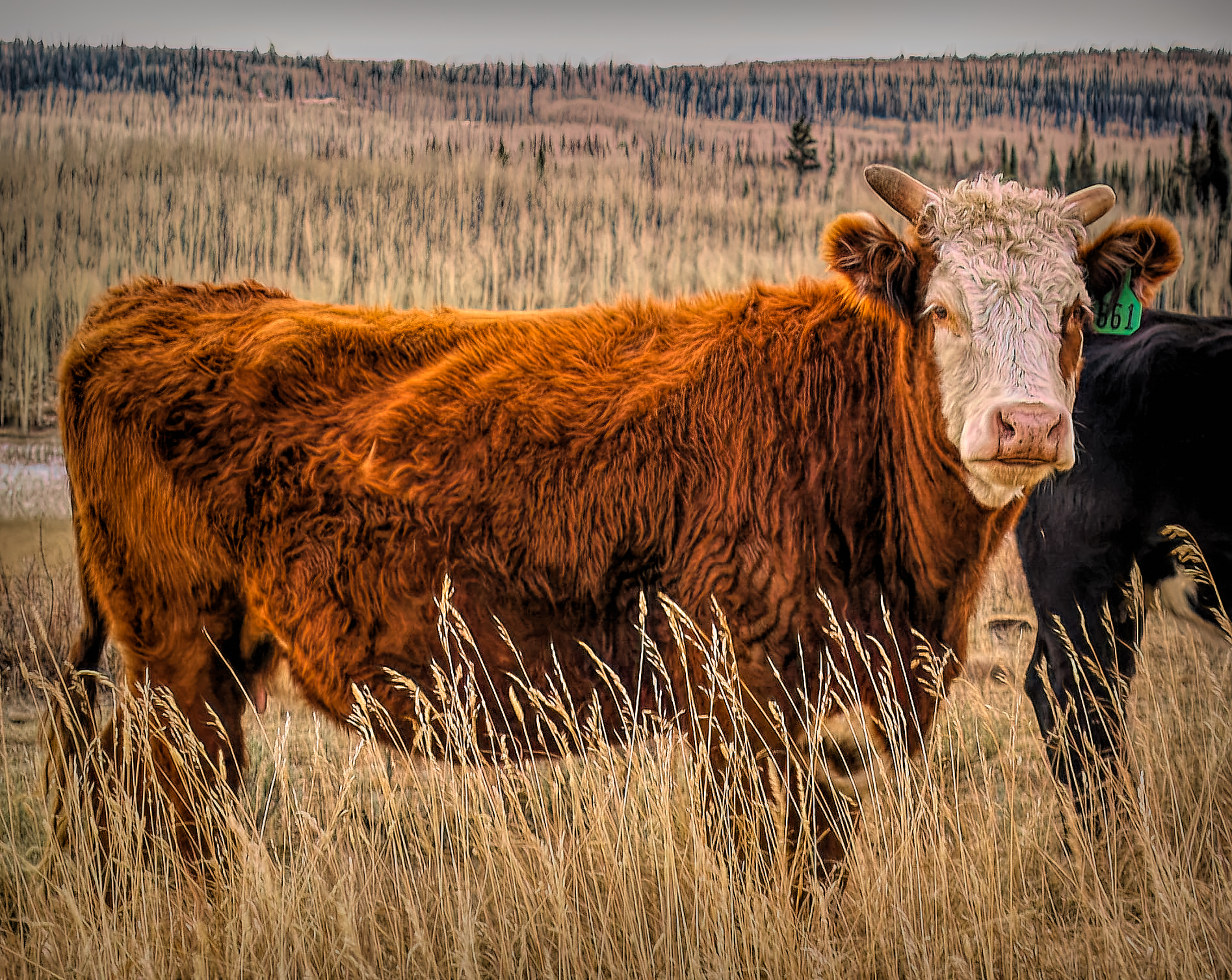


Fifteen years ago I went to South Routt County, near Oak Creek, Colorado to buy a horse. I spent three days there, meeting folks who, for the most part, had lived their entire lives in that northwest corner of the state. I heard a lot of stories while I was there. One of which I wrote about after I returned to Denver. I filled in some of that story’s blanks and wrote The Cow. Do I believe it? Of course, I do.
No moon.
The high plains of northwest Colorado witnessed the passing of critters haunting the night with a singular purpose: filling their craws and bellies. The jut of two- and three-hundred-foot tall volcanic plugs spotted the plains here and there, rising as fingers pointing to some significance above, blackly witnessing the hoots and yips of the hunt below.
An old cow had wandered purposefully from hay meadow to dense scrub. Easing down onto her belly, she raised her head, studied the night, and felt the flow of her life drain as it seeped from the pulse of pain literally oozing from her legs and chest. She smelled it as an odoriferous thing. Not good or bad. Only an abstraction. She lowered her head, a weakness in her neck begging for release. If she remembered anything, maybe it was the births of her children, sustaining them with her milk, and watching them taken from her nurture too soon. If she concluded anything at all, perhaps it was that she was ready to sleep. She had served her purpose. She closed her eyes, giving no thought to her vulnerability—the indignity of becoming only a meal for other critters intent on serving their purpose. Another abstraction.
///
Jack tied the rope to the ball hitch and looked again at what lay behind. The old Hereford hadn’t dropped a calf in two springs. She’d been on the list for auction, probably ending up as some dog’s Happy Meal, when she got a notion to try to get to the other side of four strands of barbed wire. Tore her legs and chest up. Festered to the point she’d just gone off by herself into deep scrub and lay down. Died. Chose her own way, Jack thought. But, thought too, there was something noble in such a thing, even for a cow.
Firing up the battered Dodge, Jack put it in four-wheel and dragged the cow toward the boneyard, where he and his brothers and his father before them had pulled all the critters who’d died of one thing or another over the years. It was a depression up past the hay meadow, unseen from the road, where, in time, the old cow would leave nothing of herself, but bones turned dully white, mixed in with all the others. Coyotes, maggots, some bear maybe, mountain lion, goddamned ravens, crows, and owls. All shameless in taking a piece of the rotting pie.
He drove across the hay meadow. Felt the tug of the cow—an ungraceful slog over the dip of irrigation ditches that, in a few weeks, would carry water from Bear Creek to flood the meadow and bring a good harvest.
Jack climbed from the Dodge, tipped his weathered and stained felt hat up a bit from his forehead, and leaned against the side of the pickup. Pulled a cigarette he’d rolled earlier at the kitchen table from his shirt pocket. Cupped his hand over the flame from his daddy’s Zippo, the only thing he’d managed to take from paltry leavings after the son of a bitch had coughed up his lungs. Jack’s brothers, older and more conversant with the concept of lineage, had taken their privilege in grabbing what they wanted before Jack was left alone in the bedroom to sort through what was left. Odd that his brothers hadn’t coveted the lighter.
The forever wind huffed from the north and west, goosing a response from pine, fir, spruce, and newly leafed aspens surrounding the boneyard. Brought with it the aromas and odors of the land, of spring, evergreens, horse, and cow shit.
Jack turned his head and once again studied the old cow. He’d known this cow. Passed into manhood knowing this cow. She’d dropped some fine calves, fat and sassy. But something else about her, something since he was eighteen, had caught his eye, his interest. She was independent and usually kept herself and her calves apart from the herd. Went her own way, he thought. She’d never bawl when they took her calves from her for branding and tagging, castrating if needed. She’d just stand off by herself, listen to her calf scream, and watch the process as though such a thing was an inevitability she could do nothing about.
He had never checked her ear tag to know who she was. She was known.
Jack finished his smoke, snubbed the thing out on the sole of his boot, breathed deep of the land, sighed, and turned to the cow.
After untying the rope he’d secured around the cow’s head and forelegs, he threw it in the pickup’s bed, sat to his haunches, and took off his glove. Placed his hand on her white face and gently stroked her. “You were a good ol’ cow,” he said. He pulled his hat back down on his forehead, stood up, and drove the Dodge back to the home place.
///
“You get that cow up to the boneyard?” His brother, Bob, twenty-eight, now at the top of the familial male line, said as he sipped coffee at the pine table centered in the kitchen. A new day had begun with the gathering for breakfast. The day would end with them sharing supper at the same table.
The kitchen was his mama’s space. She’d put her touch to it through the years. Frilly red and blue curtains on the east and south windows, each panel tied in the middle with strips of delicate lace. Told her boys to paint the room yellow after her husband had passed. “Make it brighter,” she’d said. A red and white checkered cloth covered the table. Porcelain knickknacks, cows mostly but some horses and pigs, sat on the windowsills.
“Got ’er up there yesterday.” Jack sat down at the table as his mama filled his coffee cup. He laid out his cigarette papers and a bag of tobacco. “Funny thing, though, that old cow had no bloat. ‘Cept for where she’d tore herself up, wasn’t any death signs… maggots, stiffness. Looked as though nothin’ was chewin’ on ’er either.” He licked the lengthwise end of a rolled smoke and gently sealed it.
Hank, Jack’s other brother, twenty-five and suffering an itch to leave ranching, go to Denver and do anything not involving cow shit, came in from outside and sat down at the table. “You take care of that cow, Jack?”
“What we been talkin’ about.” Jack tipped a milk carton over his coffee.
“Jack says she showed no sign of bloat. Nothin’ nibblin’ on ’er either.” Bob sipped his coffee and smiled at Hank. “She’s been missin’ for a week.”
Hank winked at Bob. “Some kinda super cow, I guess. Whadaya think, Jack? Or maybe she was just so damned ornery in life she just figured she’d play with us a bit. Just lay down and die, turn her meat sour, so she wasn’t no good for nothin’… not even Purina.”
Jack fiddled with his coffee cup, looking at the tabletop. “She gave us some good calves, Hank. Not much else you could ask of a cow.”
“What cow you talkin’ about?” Mama Klein bent to the stove, turned on a gas burner, and scooted a skillet over the flame.
“That purposeful old cow we was gonna take to auction. The dried-up one,” Bob said.
Jack watched his mama. She had known this cow, too. For most of her life on the ranch, she’d kept the ledgers, the histories of the cattle that had served to pay the mortgage, put food on their table, and keep the electricity flowing. She’d sit at a card table at branding time and note the ear tag numbers of the calves, trace the numbers back to the cows who’d dropped them. Determined the fate of cows that hadn’t given birth for at least two seasons. “I know that cow. She was a loner. Had a disdain for mixin’ with the herd. That the one?”
“That’s the one,” Jack said, smiling, raising his cup.
Mama Klein broke eggs and let the innards slip into the skillet glazed with bacon grease. “That cow did well by us. Worth her weight.”
Hank smiled, trading a glance with Bob. “Worth her weight,” he said as the aroma of rising biscuits seeped from the oven.
///
Jack and Hank worked the fence north of the home place on the old Reineke spread. Their daddy had bought the land after the Reinekes had given up on it, seeking less constant toil with a promise of greater rewards elsewhere. Reineke now pumped gas in Oak Creek. His wife tended bar at the Depot Café, where she listened to old men trade lies over longnecks, their butts glued to cracked plastic stool cushions, elbows propped on the oak bar top. The old men’s palms invariably brushed their cheeks, thorny from the sprout of three or four days of growth. Oil and grit-soiled ballcaps pushed up as they stared silently at satellite-fed ESPN. Missus Reineke wondered through her days, as did her husband, why they’d forsaken the land for this meagerness.
///
“Don’t look too bad.” Hank grabbed a shovel from the bed of the Dodge, walking to a failed post. “Seen it worse.”
Jack pulled pliers from his back pocket and yanked staples from the grayed pine as his brother loosened the soil around its base.
“Been wantin’ to tell you,” Hank said, pounding his boot sole on the shovel’s edge. “All that talk about that cow you pulled up to the boneyard? Didn’t mean anything by it. Bob just gets me goin’ sometimes. Hard not to get all caught up in his… Oh, I guess you’d call it sarcasm. Just like Daddy. Bob’s a mean-spirited man.”
Jack held the top of the post, watched Hank get to the bottom of the thing where he wedged his shovel against the rotted wood, and worked to pry it up. “Didn’t take offense.”
“Not that I give a shit about some old cow, but I do suppose that particular cow had somethin’ special about ’er. Noticed it myself over the years. Bob? Well, Bob ain’t never looked at a cow other than somethin’ that lives for a while, gives up some calves, dries up, and heads for the auction. But I grant you, that particular cow was notable in a way. Different.”
“Notable,” Jack said. Remembered the moment he’d spent with the cow, his hand against her face, the words he’d spoken.
The brothers worked the fence, stretching the barbed wire taut and replacing grayed posts with metal. Both goddamned the certainty that bull elk had trampled the fence, getting where they needed to go through the winter from high meadow to low, using the hay spread for cattle as sustenance. The fence became a momentary nuisance to an eight-hundred pound ten- or twelve-point bull elk. Fences were easily conquered by elk, bears, and deer. Most jumped over them, and many just walked through them. The critters did not share the notions of men who saw a fence line as an intendment, an essential component of a trinity encompassing fat calves, good harvest, and the corral of critters destined for slaughter.
A week of work on the north fence only provided the necessity to work the east and the south fence line, where acreage would soon be flooded, and hay meadows would once again bloom. The imminent dropping of calves also defined the course of labor required of the brothers, an imperative taught by their daddy, who’d inured each of them to the trudge of their days since they’d ceased suckling at their mama’s teats.
///
Bob worked on the calving barn, replacing failed slats and plugging holes in the roof. Hollered from up there for Hank and Jack to ride the high meadow to the south and check on the heifers, the two-year-olds who’d soon drop their first calves. “Ride that fence line, too,” he’d told them, knowing the hay meadow to the south would soon be flooded.
Jack and Hank saddled horses and felt the joy of the simple gift of such critters who blew from their nostrils, shook their heads, and chewed metal bits as an unsavory necessity. It was just a prelude to getting moving, to break the bounds of the stalls to which so much of their lives were confined.
Jack’d taken Rufus, a six-year-old sorrel gelding whose purpose seemed to object mightily to the presence of a rider making decisions about his direction. Out of the barn, Rufus flapped his head, sidestepped, blew, farted, lowered, then raised his head to free himself from the pull of the reins. Jack gently slapped the gelding on the neck, spoke softly, leaned forward in the saddle, and told the horse he was a good boy. They were moving and might run a little when they got to the meadow. Jack tightened his hold on the reins as Rufus adjusted his spirit to accommodate the nuisance on his back.
Hank had climbed on a paint, a twelve-year-old mare named Lucille who’d long ago figured out her place in the world. She watched Rufus gyrate through the motions of a less learned critter than herself. Then, as Jack managed control over the gelding and they began a slow walk up to the high scrub, Lucille followed behind without Hank’s nudging. She’d been through this exercise before.
As they neared the boneyard, both horses stepped off the trail, intent on distancing themselves from the peculiarity they sensed as something wrong, something not usual amongst the detritus of death.
Jack and Hank reined the horses back on the trail and saw their withers spasm, shaking and raising their heads. They neighed with discomfort.
“Well, goddamn, would you look at that?” Jack stopped Rufus. The horse turned his head away from the sight of the old cow, still not bloated or chewed up.
“Jesus H.,” Hank said, noticing that Lucille had again turned away too.
Jack and Hank sat silently, staring at the cow.
“She’s been up here five, six days, Jack. What the hell?”
“Don’t know.” Jack worked to keep Rufus steady.
“Maybe we shoulda’ set her afire. Appears nature ain’t taking its way with her.”
Jack shook his head. “No need for that. Critters’ll get to her soon enough. Just leave her be.”
Hank smiled. “You say so. Kinda your cow, anyway. Come on, let’s get up the hill.”
Jack continued to stare for a moment. Eased up on the reins. Rufus didn’t wait for further guidance. The gelding lurched up the hill.
Full moon.
A lambent glow bathed Mama Klein’s kitchen. Stoic, silent as stone, the porcelain critters on the windowsills provided a dulled hint of their vibrant colors—reds, blues, yellows. Jack sat at the table. Saw no need for illumination other than what seeped from the moon. He’d quietly slipped from his bed with a sense of something wrong, something that robbed his restful sleep. He brewed coffee, sipped it, folded his hands on the table, and looked at them as if they’d provide some solace and explanation for the night’s wrongness. He rolled a cigarette, lighting it with his daddy’s Zippo. Watched his exhale slink toward the east-facing window.
The fingers of volcanic plugs, now bathed by a full moon, gave up shadows to the land below as momentary gifts, a safe harbor for critters understanding the worth of remaining unseen by the winged hunters circling above.
Dull gray to black, silent, five hundred feet above, audacious puffs of cumuli eased across the stretch of high prairie. Settled a moment above the boneyard, above the Klein’s depository for dead critters left to the caprice of the elements—the animals now bare outlines of themselves, evidence only that they had once existed, alive upon the land. The clouds crept north, an unlikely passage given the blow of the forever wind in the opposite direction.
Jack stood up and looked out the east-facing window. Saw the black jut of Finger Rock three miles away. Saw the moon’s shadows, eerie in a way. He sucked his smoke and sighed it back through his nose. He turned toward the south-facing window that opened up to the view of high scrub and the trail leading to the boneyard, pine, fir, and aspen showing shadows of their own substance.
Jack leaned closer to the window. Saw the gray-black presence, a promise of rain suspended above the incline, almost touching the tops of lodgepole pine. Thought it was odd; the clouds’ northerly movement defied the wind’s easterly flow. The moonglow blinked, and a few seconds of total darkness filled the kitchen as the clouds slipped farther north. Jack sat back down at the table. Sucked on his smoke, wondering about the old cow, still pristine in the boneyard. The wrongness of the night had passed. He lifted his cup from the saucer, snubbed out the glow of his cigarette upon the china plate, stood up, carried both the cup and saucer to the sink, and rinsed them under the tap. He carefully and quietly slipped past his mother’s bedroom and those of his brothers. Entered his bedroom, eased back into his bed, into sleep, comforted with an understanding that whatever it was that had called him from his bed had been assuaged. How? Why? He didn’t know. But it had.
///
The Reineke spread north of the home place, and now part of the Klein’s two thousand acres gave witness to those who had come before the Reinekes. Near the Bear River, upon a slight rise, fifty yards from the flow of the water, a grayed but sturdy one-room shack snuggled into the hill, its lower half dug into the earth, the earth walls three feet up from the floor, with another three feet of pine logs above supporting the roof. The shack remained intact despite a century or more of seasonal wear and tear and the occasional river flood. Three windows, one each on the west, south, and east walls were undersized, utilitarian only to allow sunshine entrance and to disallow the intrusion of the constant wind and troublesome critters. The door to the structure remained intact, a door best suited to dwarfs, barely four feet to the vertical.
Jack, favoring Rufus—the gelding’s spirit not so much a challenge but a wonder—sat astride the sorrel, his legs straddling the horse’s barrel. He understood the spasm of the feisty gelding’s withers as the essential want of the critter’s nature to move, work itself to a sweat. He coaxed Rufus north, up to the yet-to-be-flooded hay meadow.
He reined Rufus just short of the old shack of folks unknown, folks intent on making a go of it along the Bear River, content to live within the clutch of earthen walls and a ceiling of pine. He dismounted, tied off Rufus to a cottonwood limb, and walked to the old home place of people who’d left this simple testament that they were here, solidly upon the land. As children, he and his brothers had played in and around the old shack, imagining it an impenetrable fortress against raids of White River Utes who’d once valued this land as theirs, given by Sinawav, the Creator.
Feeling a need he could not articulate, he walked the perimeter of the half-buried structure, stepped closer, then stooped to look into the interior through a tiny window. Sunlight shone through the east-facing window, painting a square of brilliance on the floor. He stepped back and almost stumbled. Stood for a moment, trying to wrap his mind around what he’d just seen.
“No, sir,” he said, shaking his head. He walked around the structure again, noting it was intact, the door stuck shut, and the windows too small for anything except rodents or birds to pass through. Finally, he stopped his pace where he’d begun it.
He turned his head, saw Rufus munching new spring grasses, saw the dot of black baldies in the distance, a Hereford here and there, a single Charolais large with a calf who studied him from just yards away, focusing her stare as if asking a question of weighty import. He turned back to the window and again bent down and peered in. “Christ A’mighty.” The purposeful cow lay there, her white head fully framed by the sunlight. It can’t be!
He stood up, backed away, ran to Rufus, pulled the tie rope from the tree, and mounted. He clicked his tongue against his cheek and gently slapped his heels against the horse’s barrel. Stuck his hand atop his hat and pushed it down securely on his head. They galloped south.
Jack slowed Rufus at the foot of the trail. The horse blew, snorted, and shook its head. Nearing the boneyard, he expected the same reaction from Rufus, the same intent to shy from the place. But Rufus kept to the trail and seemed to calm himself as they approached. Once there, he reined Rufus to the depression of land where decades of bones lay scattered by the critters gnawing or picking the meat from them. He halted Rufus, held the reins in his left hand, and dismounted. Studied the leavings of the dead. The purposeful old cow wasn’t there. Her bones, newly stripped, were not atop the others. Knew this revelation, whatever it meant, would not be shared with his brothers or mama. This thing was his and his alone.
///
In time, Hank’s itch to get off the land came to pass. Bob and Jack bought out his share of the ranch. He headed for Denver, where he found little gold in the glitter. Quickly burned through the cash he’d arrived with. Worked on cars and did some carpentry and plumbing. Aged himself into a life of lost dreams. Often thought about the land, the ranch. Married twice, divorced once. The second wife just left one day and never returned to the little house crammed in with others in a neighborhood of postage stamp front and back yards that bordered narrow streets and skinny alleys.
Mama Klein died on a Sunday in her kitchen as she dusted her knickknacks. Fell to the floor with the punch of a freight train slamming hard into the left side of her body. Bob and Jack buried her ashes next to their daddy’s in a high meadow surrounded by aspen.
Bob eventually married and had two children. Girls. Wondered why the Good Lord had done such a thing to him. The girls considered cows as shit machines and horses as oddities. Lowered their eyes and giggled at the exposure of penises longer than their forearms. The girls came to value pom-poms and quarterbacks to the exclusion of the land and the critters upon it.
Bob was able to see his girls grow into adulthood. But he couldn’t stop the blood clot from slowly entering his brain. So he toppled to the ground on another Sunday morning as he pulled a calf from a heifer that’d not yet gotten the hang of birthing.
///
Oak Creek is a lazy burg near Yampa on the High Plains of northwest Colorado, a two-minute wide place in the road for those taking the scenic route to Steamboat Springs, where million-dollar condos house the seasonal influx of the affluent. Up a side road in Oak Creek is the old train depot, the first floor now a bar frequented by the locals, ranchers and coal diggers, and those servicing the needs of folks ensconced in the comfort of their wealth in Steamboat. The bar offers burgers, fries, other tasty fares, alcohol, and cable-fed ESPN.
///
Now older than he ever wanted to be, Jack sits at the bar in the old depot. Has pushed his sweat-soiled hat up a bit, leans over a longneck, and smokes a hand-rolled cigarette lit with the gold-colored Zippo. His ass rests on cracked plastic, crisscrossed with gray duct tape. He’s bookended by two others, gray-haired, both stubbly-faced from the lack of necessity to shave daily.
“Your heifers about ready to throw their calves?” one of the men asks Jack.
“About to. Keepin’ an eye on ’em,” Jack says.
“You short-handed now that Bob is gone?” The rumpled geezer on the other side of Jack says. “I guess I could give you some time with them heifers.”
Jack draws on his cigarette, lets the smoke slide from his mouth and nose, and puts the cigarette in the little brass ashtray. He tips his longneck to his lips. “Well,” he says, placing the bottle back on the bar, “I guess I got it covered. Got some hired help out there.”
Jack and the two grizzled presences on either side of him watch the flash of ESPN, smoke their poison, and tip bottles to their lips. Jack wonders if these old boys also consider their immediate future undefined. Something encompassing their slip-slide into an age where they each figure their worth as men upon the land wanes. Wonder if all they have left is their memories surrounding their youth, now lost to hired hands, to young men whose commitment to the earth and the critters upon it pretty much pales to the worth of a paycheck.
///
Jack Klein never married, never took his yearning for another man’s love beyond the yearning stage, as acting on such a thing had been thinkable but impossible. Never saw the need for family other than what the land provided. Now, he sits alone in the kitchen of the home place that had once witnessed the chatter and nonsense of kin resolute in the singular urge to harden the glue that held them together—the land and everything upon it. Jack sips coffee and smokes his cigarette. Wonders if his hired hands have taken his earlier direction to complete tasks he sees as essential. Thinks they probably just while away the hours, not engaged by the urge to do right by him, the land, or the critters. He glances at the delicate caricatures his mama had long ago placed on the kitchen’s windowsills, now undusted and unmoved for so many years. Stands and puts his coffee cup in the sink. Turns off the light and walks down the hallway to his bedroom. He pulls off his clothes, tugs the bedclothes to his chest, and stares at the night around him. Thinks it significant that he’s slept well, undisturbed for years, ever since that night he’d seen the black billow of cloud creep north, not a drop of rain let loose as it passed. Ever since that day, he’d found that old cow still whole in the old shack, undisturbed by the want of nature to return her to dust.
///
Come daylight, Jack mounts the six-year-old purely black mare he’d named Mary. Just Mary. She was a gentle soul bought at auction a year before. She’d caught his eye with her own. Seemed to Jack she had seen something of his soul that day of the sale, something deeply personal that he’d never shared with anyone, but damned if she hadn’t seen inside him. Corralled amongst many, her black coat shining like silk, her eyes engaged with his own. He’d shaken his head and acknowledged her insight, believing she knew more about him than he did about her. Had seen the worth of taking her home.
“You know the way, Mary.” Jack barely reins the mare, the daily routine now known by the horse, their course set for the old Reineke spread and on to the shack by the river.
Mary stops just short of the half-buried structure, lowers her head, and begins to munch sprouts of grass. Jack dismounts, knowing he doesn’t need to tie Mary off. Knows she will stay close and come when she’s called.
He walks within ten yards of the shack, sits on the meadow grass, lights up a cigarette, and huffs the smoke to the sky. Looks at the brilliant blue above. He’d long ago stopped checking on the interior of the shack. It was always the same. The old cow still lay there as if sleeping, unspoiled, not ruined by the ravages of nature. He’d ceased to wonder at the mystery of the thing. It was what it was. Hell, he was too damned old to ponder the meaning of it all.
After half an hour, Jack whistles to Mary and waits for the mare to sidle up to him. Then, ready to mount her, he turns back to the shack. Ponders a moment about what has just crossed his mind. Steps away from the mare and pulls his Zippo from his pocket. He sits on his haunches in front of the tiny east-facing window, fingers the lighter, and opens and closes the top with his thumb.
“Yessir, you were a good old cow,” he says, staring at the lighter momentarily, thinking something of himself ought to be there with her. Smiles with the childlike, foolish thought but tosses the Zippo through the little window into the blackness within. He mounts Mary, pats her softly on the neck, and speaks to her the simple words of an old man who has come to value quiet conversations with horses. “You go where you want, Mary. Got nothin’ but time.” As they move on to wherever Mary has a mind to go, Jack looks back at the old homestead, sunk halfway into the earth. Then, satisfied that the Good Lord works in mysterious ways, he pulls his hat off and lets the forever wind cool his brow. Laughs at himself and says to Mary, “Good Lord had nothin’ to do with it.”
///
Jack props pillows against the headboard, raises himself, and glances at his bedroom window. Sees the moon is full, the glow framed as a picture. He reaches over to the side table, rolls a cigarette, and lights it with the blue plastic BIC he’d picked up at Reineke’s gas station. He watches the smoke lose its substance, fan out, and fade to nothing. He smiles. Sees the moon glow blink to black for an instant, then return. Remembers another time, another cloud that had paled the moon. He caresses the thought carried at the back of his mind and in the center of his soul. It is a wish for the honor to lie next to that purposeful cow at the edge of the meadow within the embrace of earthen walls.
///
Jack’s bed is empty, the bedclothes still pulled up to the pillow, a BIC lighter, a bag of tobacco, and rolling papers on the side table.
The first light of day turns the meadow golden. The forever wind has wound down to a quiet and soft breeze, and the rush of Bear Creek is heard as a melody to those men and critters who find it in themselves to listen. Just listen. Mary—no tack, no saddle—munches grass hay stubble in the meadow near the grayed shack half-buried in the earth. She has become a purposeful horse, managing to free herself from a corral of pine poles rotted with age. If, at this moment, she remembers anything at all, it is she had seen the hunger for the earth’s perfection in the old man’s eyes. If, at this moment, she concludes anything at all, it is she has served her purpose and has come to understand the portent of a dry cloud shoving against the constancy of the forever wind.


